
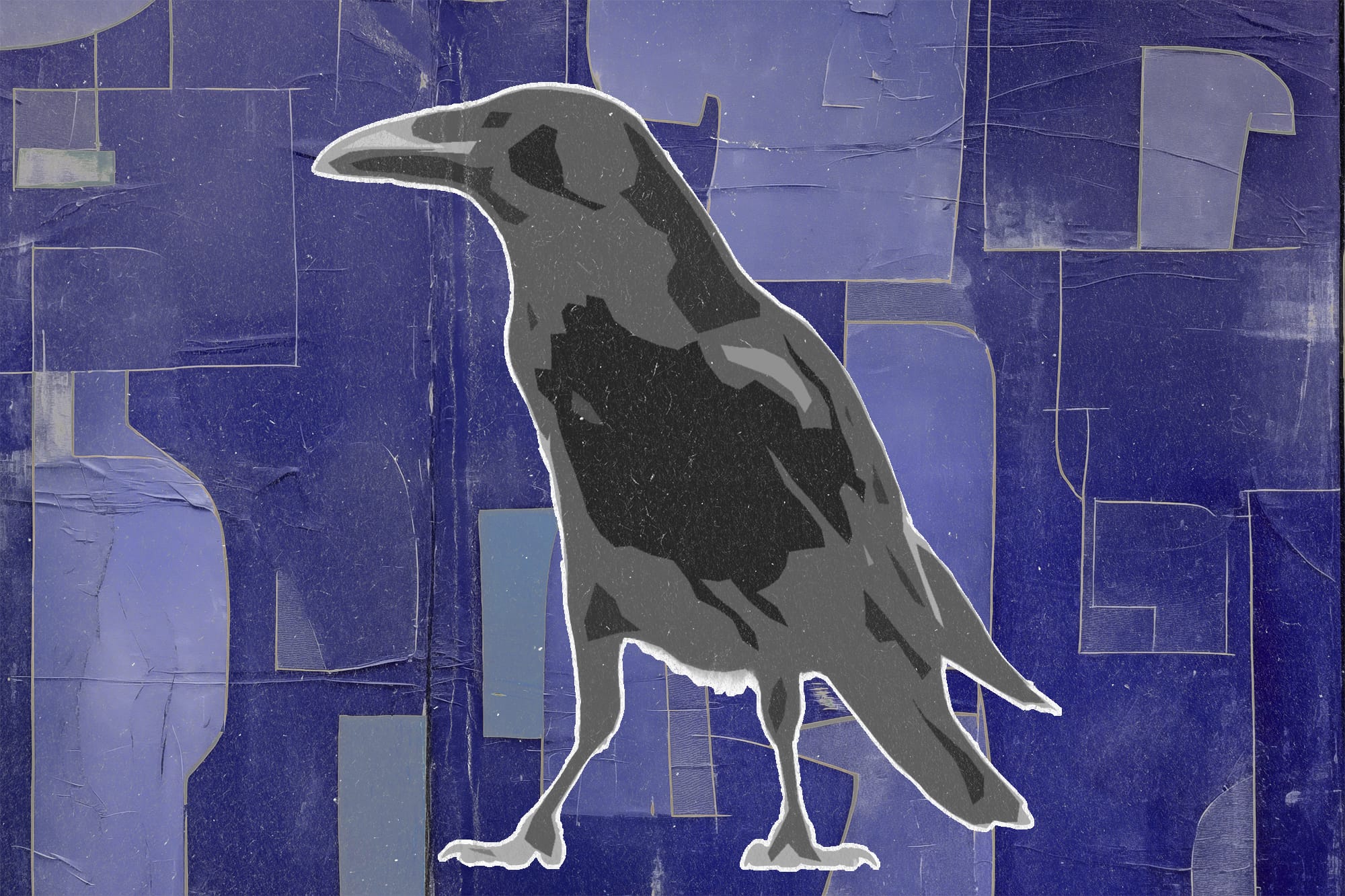
All crows are smart, but Pimavanserin is the smartest. It was she who long ago domesticated the fierce coyotes of the desert. Now, she perches atop the highest spire of their roost, the most splendorous cactus in this land of red clay, and waits—every day—for Flanders, George.
Crows have no equals except, perhaps, for the great apes. The beasts seldom bother the flock, confined instead to their shiny white building, transported away and back again by the metal boxes they’ve tamed. Occasionally, the crows need some service from the apes, so they’ll ingratiate themselves with an offering—a gift—invariably taken from another of their kind. (Apes haven’t the intelligence to consider the origin of things.) Still, it’s never happened that one has humbled himself enough to make a crow such an offering. That is, until Pimavanserin.
Flanders, George is a hairy ape. He wears a gown to just past his knees and a pair of slippers that sometimes falls off in the sand. Shoeless or not, he smiles whenever he sees Pimavanserin, and chants her name: constantly, happily, the first gift he ever gave her. Every day, he slips her a small plastic cup and, as if by magic, reveals two orange pellets under his tongue, gleefully depositing them for her.
“Pimavanserin, pimavanserin!” he says, and the crow takes it from him.
There’s no value for her in this exchange. After he leaves for the day, she carries the cup to the deadlands and disposes of it where he can’t see. (For the apes, whatever doesn’t exist before their eyes doesn’t exist at all.)
But there is no gift-giving without service. Flanders, George has a bracelet around his hairy wrist, and he tugs at it restlessly, holding it up to Pimavanserin and pleading with a whimper. She relents and comes down from her perch. Using her sharp talons and dexterous beak, she frees him from his restraint.
He whoops and she knows her friend is happy. He pats her head once, twice, three times before scurrying into the desert as he always does, away from the others who chase him.
On a cactus spike, Pimavanserin pierces the bracelet with all the rest. Examining it might help glean some insight into the impenetrable world of the apes. She cannot decipher the glyphs, but they’re minutely different from similar bracelets scavenged from bins outside the great white building.
“FLANDERS, GEORGE,” it reads. This is always the first line, so it’s what Pimavanserin associates with him, though she yearns to learn his true name and the meaning of the other unique script. For the repeats—“NAME:, DOB:, SEX:, ROOM NUMBER:, UNIVERSITY OF NEW MEXICO NEUROLOGY CENTER”—she gleans little significance.
A day passes, and he does not come. She’d like to think nothing of it, but it’s all she can think about. Perhaps the break from routine has her restless, but by the third day, she knows it’s something more. Flanders, George is hers, and if it becomes known that any animal has preyed on him, she’ll use her influence to whatever end.
But the fourth morning, he comes walking out as he always does, in his little gown and slippers. He is still hairy, but his skin is pocked and fraying, symptomatic of sunbaked carcasses that litter the desert floor.
Today, she glides to him. He does not greet her by name, rather falls on his freckled knees. There is no plastic cup for her. Instead, Flanders, George touches the inside of his throat and retches the contents of his stomach onto the sand.
Pimavanserin is dumbstruck. Sure, when she had her young, she fed them in this way, but certainly Flanders, George understands he’s dealing with a mature crow—indeed, the wisest of them all. If he means to offer her food, why would he infantilize her?
With no thought for her, he runs into the desert—before Pimavanserin can tear his bracelet, before he can pat her head. The others come and pull him away. Apes never prey on each other, but Flanders, George wails like he’s being eaten. The smile is gone from his face as he disappears inside.
She searches what he’s left and collects them: the same two orange pellets. No crow has ever entered the white building, just as the apes have never invaded the desert—a gentle truce. Clasping the last bracelet he left her, Pimavanserin decides she will be the first. For his sake.
The closer she gets, the less shiny the building becomes. Instead, the sides of the structure give way, like the skin of larvae, and reveal their internal matter. Dozens of apes reclining, some peaceably, others thrashing wildly about.
It’s not long before she finds where Flanders, George must live. She knows this because the walls are decorated with drawings, crude forms of an ape and a crow together laughing, adventuring, being. He and she.
She cannot get closer because of the building’s invisible barriers, but within the room sits another ape who looks just like Flanders, George. But this one’s bracelet is gray, its skin whole and healthy. Though it wears no gown and slippers, it is hairy and has his same freckles.
It notices her and approaches the barrier. Pimavanserin cranes her neck to read the simian glyphs on its wrist.
“VISITOR NAME: FLANDERS, AMELIA.” What could this mean?
She’s never made an offering to an ape before, but she humbles herself, depositing the orange pellets onto the outside ledge along with Flanders, George’s bracelet.
“Pimavanserin?” it gasps, staring at the offering. Relief fills her. Flanders, George told it her name. They look into each other’s eyes. Between species, there’s only one true understanding: There is no gift-giving without service.
Flanders, George enters the room, and Flanders, Amelia embraces him. He looks bewildered, but that’s okay. From now on, Pimavanserin would come to him. And together, they would heal whatever it was that took his smile away.