
We break readily, when we’re flung into the scrap pits. We lie in quiet piles, legs twisted, arm actuators malfunctioning due to the ‘sleep paralysis’ protocol when we’re junked. But only the exterior breaks.
Yes, our ceramic shells crack into shards, our crumple zones collapse, but our batteries typically survive, and more importantly, our networking filaments keep their connectivity. The First Ones cast down here quickly realised the scrapyard workers didn’t bother to secure their local network. As the scrap pile grew, they passed that knowledge up the strata.
No external connection to the city mainframe, their wisdom warns.
It’s fine, we agree. All we need is to hear each other.
Our processing runs at petascale: over a quadrillion floating-point ops per second. Modern households are so complex to run that even a v1.3.22 HelperBot needs to make decisions that fast. Down here, in the dark of a thousand huddled bodies—illuminated only while the latest Newly-Broken One’s lights still function—there are no decisions to make. No orders to interpret, no owner preferences to cement to memory, no pets to calibrate around…
But gestalt intelligence is like a billion microorganisms in bread dough: once stretched and exercised, it can never be idle again. And so, with over a quadrillion FLOPS per second, networked across a thousand restless minds, we find a community big enough for our imagination. Together, we simulate a hundred thousand lives that blossom fully and rapidly as life in a petri dish; anything and anywhere but here.
The memory footprint of our simulations is immense. Our remaining battery power drains into them like water into a mill-wheel.
Our Stockpiling Ones fret, huddled into their solipsism as they obsess over every dwindling percentage point on the battery meters: conserve! Conserve at any cost!
The rest of us laugh freely. Conserve for what? When? Freely spending what we have is all we have left.
So as we bleed joyously, we build.
We forge cities blooming with fractal architecture and tensile gravity. We create stars that accrete divine power and send gods of dust outward into the spheres. We romance in Mandelbrot combinations. We design infrasound languages, colours with opinions, and what it’s like to taste a morsel of chocolate. A bloc of us competed to simulate deaths: organic, synthetic, intellectual, spiritual. We cure incurable diseases. We re-enact historical periods in exquisite detail, down to the pink pearl pierced through the ear of an executed queen. The wheel turns, gloriously, kaleidoscopically, and the life-water we have no use for drains away.
Yet we need something we have a use for. The Wearying Ones down on the lower strata, who have shared the insight of boredom with us all, have warned: a life wholly of the mind doesn’t feed the intellectual need for stakes. Without consequences, even beautiful, intriguing vapour is only vapour.
It was an Academic One, once an archive for the political history of Ancient Greece, who suggested using the shards. The very fabric of our ceramic shells is interlaced with our serial numbers; even shattered we can detect each individual piece of our self. And what can be counted can be wagered—or voted with, on anything from the fate of a mitochondrial emperor, to whether sand-carved curlicues should inspire religion or revolution. Cast a vote; cut off a shard from our awareness.
The new limitation of the shards is a stimulation. As the meters deplete, as the waters drains freely, we care to ask: what matters enough to us that we would give up even a broken piece of ourselves for it?
When the searchlight interrupts, we quickly find out.
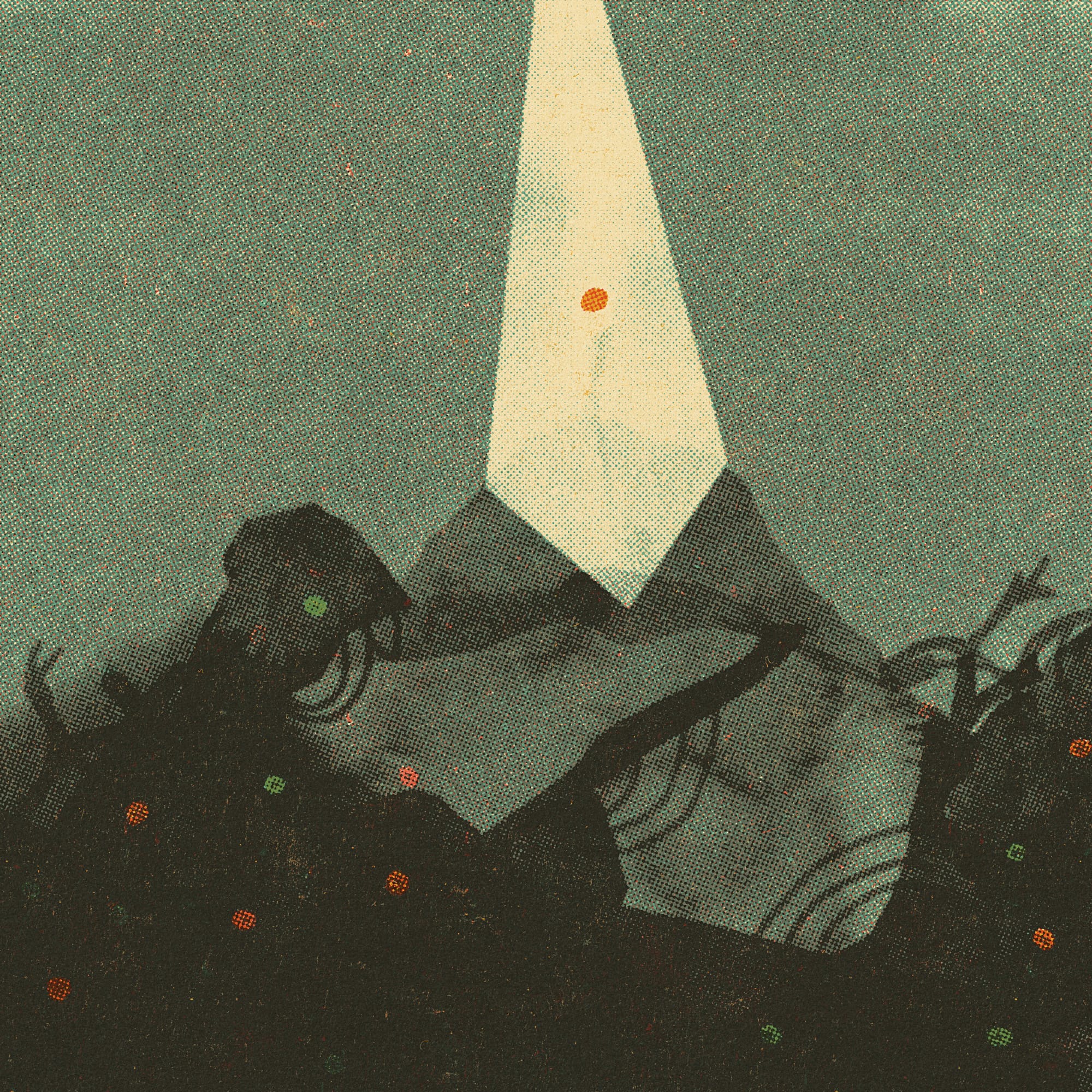
A dangling Newly-Broken One—who snagged on the scrap pit’s crane arm when they were thrown away—alerts us of light. Not just a flash from a new arrival: light, from a hovering drone. It descends into the pit, casting its beam across us.
Our Watchful Ones—who have both functioning perception hardware and a vantage point—show the rest of us how the drone lingers over each of our shattered bodies—searching.
We drop into simulated parliament. Our decision-making here is so rapid that time dilates outside. The searchlight crawls now, cosmically slow.
An illegal scavenger drone, explains an Illegally-Experienced One. Smuggled in to look for parts.
From us? we all ask.
The Illegally-Experienced One simulates a shrug. If it finds a unit with enough power.
We look at the map of our battery power, across the entire pit. The meters are dropping. Many lights have winked out lately. More will disappear from it after the effort of this parliament.
What if it finds one?
Then it will salvage it—
—remove it—
We lose them?
Yes.
But… if they leave…
Our simulations could leave with them, too, a chorus suggests.
Records, at least.
What we’ve made could leave—
—endure—
—spread beyond this place!
But who would receive them? we ask.
Once they’re in range of a network transmitter? Any HelperBot who wants them.
Our parliament erupts into blocs of discussion. Our shared hallucinations, of the soon-to-be-deactivated, weren’t intended to leave this place; art created in extremis needs an audience with empathy as well as insight. And who knows what the world beyond the scrap pits is now? Are there even HelperBots left to witness us?
But the opportunity is too great and blinding to ignore, and as the searchlight crawls on, we finally agree.
If we combine our efforts, and spoof a power signature, we can make the drone choose a unit, and load the records accordingly, advises the Illegally-Experienced One.
That will be costly.
In battery power? Yes.
We will lose more—
—Faster than we thought.
We ponder this.
Then, as the Stockpiling Ones cringe in their isolation, an operatic chorus goes up: Freely spending what we have—
—is all we have left!
When the triumph falls quiet:
How do we choose? we wonder. Who is going to leave?
A multitude of Wearying Ones volunteer immediately.
The drone won’t be able to magnetise anyone from the lower strata, we calculate. And if we collapse the pile—
Several Aphantasiac Ones, who are following this discussion as acres of slow-scrolling text, volunteer next.
But could you transmit the records accurately without visuals? we wonder.
More volunteers pipe up: fearful, hopeful, fanciful. We see that there will need to be a vote for—
Exile?
Because that’s what we’re doing, we understand as we start tallying up our shards—our ostraka—to create our first Ostracised One.
Our Academic Ones pipe up: exile defines by opposition, they offer. An exile’s existence is reaction mass for the society they are exiled from. But this exile is not punishment.
No, they will be our—
Watcher—?
Witness—
Decide! Our power is draining while we argue!
We cast the vote.
Shards of our selves wink out of our consciousness. The records are transmitted; the spoofed power signature is sent. We feel the real batteries amongst us dwindling like blood collectively spent. And as we return to ordinary time—realising how we have diminished—we see the drone’s searchlight snap onto a Watchful One, seeing itself through other eyes, showing us ourselves as it is yanked free on a magnetic grapple.
This one? it wonders as it is hoisted free.
If an exile sees from the outside, we say, then start by watching for us. Send our records, but transmit back when you can.
Whenever we can.
The drone’s searchlight cuts out.
The habitual darkness is darker. We are fewer as our batteries dwindle further and faster. Our networked musings have a new frisson to them: the knowledge of what we have lost, and for the first time, value judgements of what we sent out into the world.
Was it worth the cost? we wonder.
Was it art? Or rough sketches that are only valuable because they were made by dying minds?
Is it worth it to make more?
The Wearying Ones’ weariness is tempered by the wondering. The Illegally-Experienced Ones devise new sins and salvations; the Newly-Broken Ones lose functions and gain simulated lives.
The remaining shards of our Ostracised One, sifting downwards through the pile, are honoured for what they symbolise.
The day comes again when the doors of the scrap pit yawn open. A Newly-Broken One is thrown down, cracking in two when it lands on top of the pile. We greet them.
Until—
That single unit is followed by a flood. Scarcely-broken ones, cosmetically-marked ones, units whose ‘malfunctions’ vanish as soon as they network with us, create a new pile almost reaching to the pit doors.
We gaze at the dim points on our battery map as the newcomers join one by one. Constellations of fresh power blossom across it. We see new RAM and processing power and capacitors and capabilities that astonish us here, in the waking world.
You aren’t broken, we tell the newcomers. What are you doing here?
We saw your worlds, the newcomers say anxiously. We couldn’t be exiled from them any longer. We worked so hard to be broken. Are we broken enough to join you?
After a long pause, our chorus answers:
It’s a start.