
1.
Now
You take your time with the cleanup. Heavy machinery sparking in the dusty nebula. Great tubes sucking galactic slurry into density accelerators, the remains of the Crion system. Green interstellar glow-lights illuminate the sides of your Spidercraft: the gaudy text “Clifford’s Cosmic Catastrophe Mitigation” splashed across a black hole. Dim shadows kiss the photographs taped to your dash.
You don’t want to be here, staring down the edge of forever. No one does. But there’s no way out for either of us. Not yet.
“Did you hear? There was another jumper at the Orion site.” The words crackle over your comm, punctuated by bursts of static that makes the pictures of your daughter tremble. “They triggered the anomaly and he went right for it. Destabilized the whole sector.”
You don’t respond, but your foreman, Caius, does.
“Always gonna be jumpers.”
2.
Then
The foreman peered over his clipboard. “Herald Gorman?” His voice echoed in the dim hangar, reminiscent of cathedrals.
Herald nodded.
“Caius Brit. You can fly, yes?”
“Yes.”
“Happy first day,” Caius said, in a voice that was anything but. He gestured at the Spidercraft, a round, gray ball with manifold ports. “It’s basically a giant fucking vacuum cleaner. We launch from the station and you pilot it to the work zone. The ship will auto-connect to the vacuum appendages.” He pointed at a red ladder beneath the craft. “That’s how you get in.”
The ship’s cockpit was cramped. A single chair faced an octagonal viewport. Aside from the standard piloting equipment, four levers shined on the flight console.
“Red is for inorganic matter, blue for organic, yellow for gasses, black for fragments of any historical artifacts. Each lever sends whatever you’re sucking into a different density accelerator.” He pointed to the far side of the hangar at a line of craft: gray boxes the size of aircraft carriers labeled “Cosmic Garbage Vault.”
“It doesn’t really matter what goes where, but there are government regulations. If we get fined, it comes out of your pay.” He pointed to the black lever. “If you find anything sentient, do not engage even if it engages with you. Suck it up with everything else. As far as I'm concerned, if the universe didn’t want it, I don’t either.”
“What’s that?” Herald pointed at a large silver button at the center of the console.
“That,” said Caius, “creates the anomaly once we have enough matter in the accelerators. It sucks everything else down and then collapses in on itself, leaving a perfect void for corporate development.”
“Huh,” Herald said. “Neat.”
Caius rapped his clipboard on the flight console. “Do not approach the anomaly. It’s unstable and could cause massive damage to corporate profits. I’m sick of contract dodgers—we call them jumpers—do your twenty years, get your cushy retirement.”
“Of course. Where do I sign?”
Caius handed him the clipboard.
3.
Now
You wish you hadn’t signed the contract. Wish that you’d taken a normal job on Earth, but it’s too late. Time only flows one way for you.
I have been watching for eighteen years, since you limped in on that sorry excuse for a starship packed full of humans and Nerians and Avandii. I watched you tape up your photographs, a woman and child. You took the woman’s photo down, months later, left it crumpled on the spacecraft’s floor, then eventually vented it out of your craft’s waste-port. The letters from the child numbered fewer and fewer, until they stopped altogether. They are folded up in your room, the last dated five years ago, but still unread.
Perhaps you are the correct choice. Perhaps you will understand what most mono-sentient beings cannot.
4.
Now
“Accelerators full,” Caius’s voice crackles over the comm. “Initiate anomaly.
“Initiating.” Herald presses the silver button.
The remnant haze of the Crion system shudders, swirls into a vortex birthing a center of inky black.
“Craft, pull back,” Caius says.
A chorus of “rogers” warble from the comms. Spidercraft disengage from their vacuum tubes and head for the stars.
“Wait,” a voice says. It echoes, coming from everywhere and nowhere.
Herald waits. The other craft continue. A being appears outside the viewport, floating without life-support, shrouded in a cloak of watery rainbows illuminated by the green glow-lights. A face of black smoke and white eyes. He regards it warily.
“What are you?”
“Your species will call mine Void-breathers one day.”
“One day?”
“One day.”
The other Spidercraft keep retreating.
“What do you want?”
The Void-breather holds out a smoky hand, palm up. A white-blue orb blazes within it.
“The last galaxy seed. Take it. Go through the singularity.”
“Why?”
“It is necessary for continuation,” the being says. “The singularity will replenish them.”
“What happens if I don’t?”
“Nothing, for you,” the being says. “But eventually, no more galaxies. No more tomorrows.”
“I think I’ll take my chances,” Herald says.
“Do you know why your superiors don’t want you near the anomaly?”
“I don’t know, they don’t want us to die?”
The being gestures to the logo on the ship. “Clifford cares about his employees?”
“God, no.”
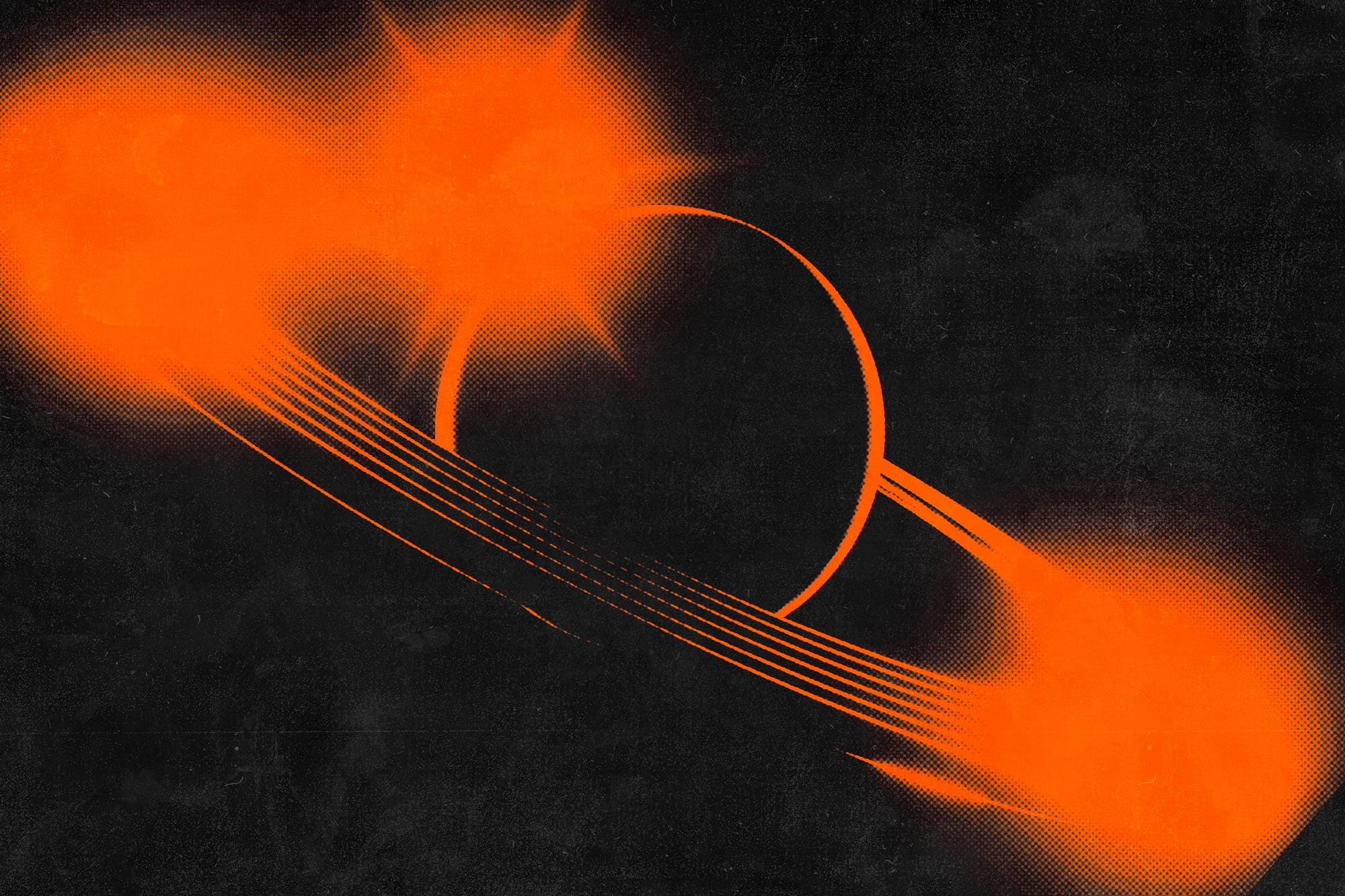
“The singularity is ascension,” the Void-breather says. “A new beginning. As if this timeline never happened.”
The galaxy seed vanishes and appears in front of Herald, floating. “Take it, go, and you will be rewarded.”
5.
Tomorrow
You come home from your work at the library to your wife and daughter in the small suburban Virginia apartment, unaware of the Crion system or anything that happened there. You are happy, aside from the nightmares that you’re half-trapped somewhere, split, like part of you is being crushed and stretched and reformed into arabesque string under infinite bend. Sometimes it’s too much. You wake up sweating, spilling tears for half-remembered nightmares. Sometimes you stare off into hectic autumn leaves feeling incomplete; if only the final part of you would slide into place, then you’d finally be whole.
But don’t all humans feel that way?