
(CAMERA zooms in on Earth, on North America, on the state of Illinois, on the city of Chicago, onto a crowded street on which The Top Hat Tavern is located.)
(VOICE OVER begins:)
On Earth, there exists a most extraordinary species. With its intricate social behaviors and bizarre mating rituals, the magnificent ^^barfly^^ is worthy of intense observation. Their colorful personalities are aided by the fermentation of such naturally occurring sugars found in honey and fruits. Swarms of barflies can be found in nearly every corner of the planet. But what do we know about this magnificent creature?
As the name suggests, they are most often found at a bar. However, they can also be found at a pub, or, maybe a watering hole (though not the same as those we talk about, say, on safari). They might also be found in other similar environments such as a public house, an alehouse, a brewery, a tavern, a beer garden, a taproom, a roadhouse, a gin mill, a speakeasy, a joint, a dive, or a saloon. Indeed, it seems that as long as the setting contains fermented liquids—and plenty at that—the barfly is at home.
In this episode, we will introduce you to barflies at one such establishment, The Top Hat Tavern. It is a habitat, like many others across the world, that is now at risk of certain obsolescence. With the arrival and sudden mania of the ^^Kava^^ Cafes and ^^Kratom^^ bars, along with the recent legalization of marijuana and influx of dispensaries, it seems the home of the barfly may be going the way of the dodo, and with it the barfly.
You see, it is up to the barflies and the barkeeps to protect the existence of their environment. The best way to do this is to ensure their home is frequented often and its nectar depleted. This depletion secures the environment of least another month once rent is paid.
(CAMERA pans to the entrance of the bar, moves through the door.)
With the exception of the giant, faded black ^^top hat^^ that makes up the tavern sign, The Top Hat Tavern is an unassuming atmosphere. The stools are simple circles, silver appendages, green (also faded) vinyl, and no back rests. Many are ripped and held together with duct tape. Most swivel, and those that do not have likely been broken for years.
Ten stools line the bartop at any given time. One must walk about twenty feet from the front door, above which two small golden bells were placed long ago. This is an effort to alert the bartender of the barfly’s arrival should they be in the back counting or stocking inventory as his job sometimes requires. A handful of four-top tables are scattered about between the door and the bartop.
It is the bartop that is the most outstanding feature of The Top Hat Tavern; it is old, wooden, and ornate. Some believe it came straight from Ireland, broken into parts to make the journey. It has become the topic of many a conversation and indeed wagers of all kinds (though usually in the form of sustenance) have been made as to the truth behind the mystery of the bartop. It is thought that only a few know for sure.
Behind the bar are what will be found in any environment we’ve since mentioned—shelves. These include a top shelf on which the best liquor—or at least the most expensive—will be displayed. This allows our specimens to easily choose their ‘poison,’ a common slang for liquor.
The acknowledgment of a top shelf implies a bottom shelf. On this shelf is all the cheaper—albeit not necessarily worse—liquor. These are also called ‘well liquors.’ This is quite often the liquor our barflies prefer. It has been discovered that the sheer volume our subjects imbibe necessitates the need for more economical forms of intake, while also aiding the environment in its longevity.
There is also an ice machine, a few sinks, and a speed rail. The latter is the container below the bar from which the most common liquors are poured allowing for easy access and a speedy pour.
Also behind the bar is the aptly named ‘bartender.’ He or she tends the bar. This primarily consists of pouring the libations for the barflies, but it will also include such duties as washing dishes—this usually occurs in a three-sink system whereby the pints and other glassware are first dunked into soapy water, then rinsed in clean water, and finally, submerged in the third sink for chemical sanitation. After which, the glasses are again deemed hygienic and put back into rotation. The mere existence of the barfly confirms this process’s reliability.
Other duties of the bartender might include the cessation of service for a barfly should one appear intoxicated or otherwise unruly; a side effect of the fermentation. This act is called ‘cutting off,’ as in, the bartender ‘cuts off’ the barfly’s supply of sustaining liquor. This is sometimes quickly followed by the bartender, or at more established locales the bouncer, whose job it is to ensure a ruly environment, removing the barfly from the habitat should they behave recklessly in reaction to being cut off (barflies do not take kindly to having their sustenance removed. Can we blame them?)
It should be noted that this has become a last resort now that many environments are struggling for survival. It surely seems counterintuitive to remove one’s lifeblood. However, the safety of the environment can often be at risk once a sloppy, drunk barfly becomes disorderly and is not swiftly removed.
(CAMERA zooms to a barfly, FLOYD and the barkeep RAY.)
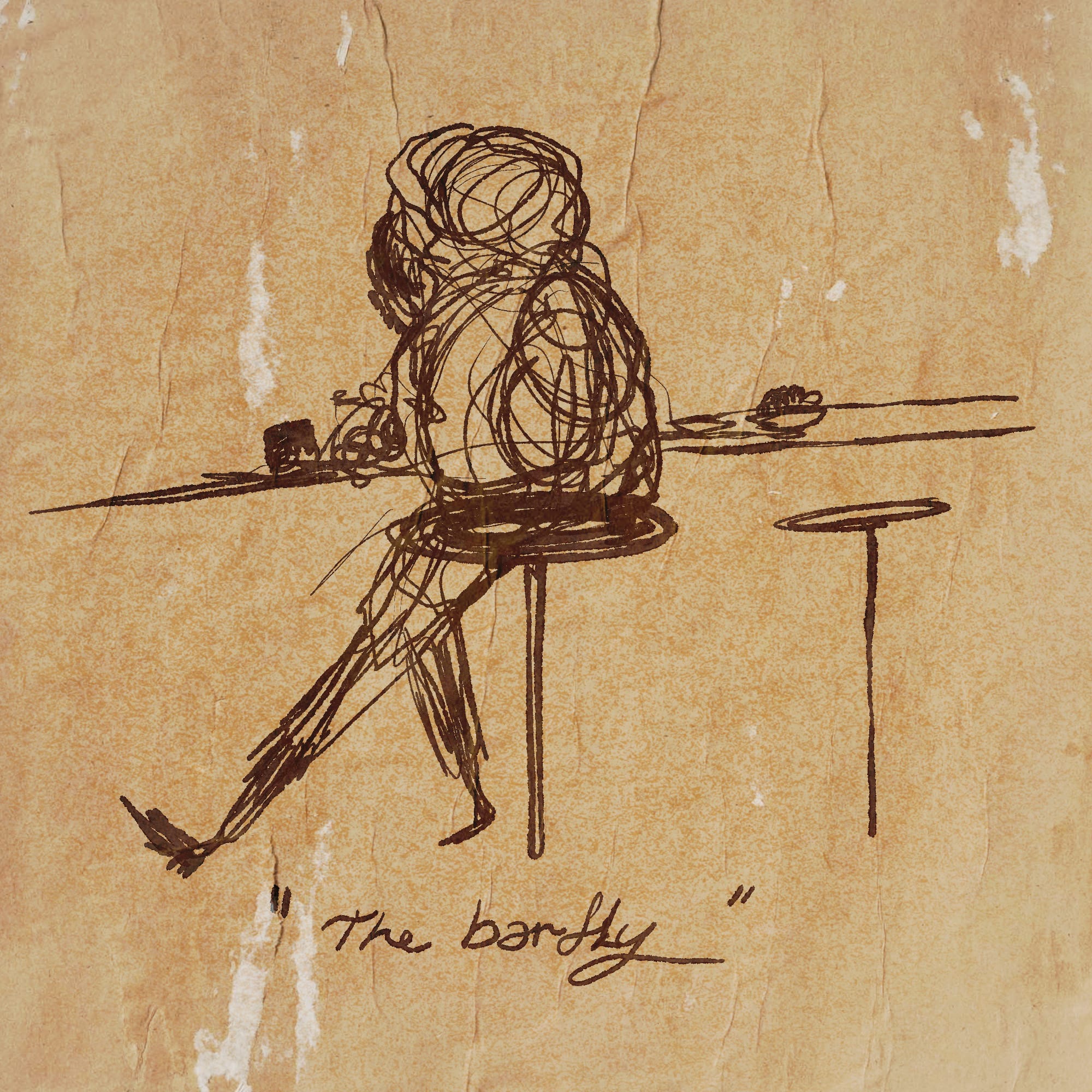
The bartender is also often obligated to engage in jovial conversation with the barflies. You might even spot him doling out advice from time to time, sage or otherwise. It is in the bartender’s best interest to be personable and engaging. This is because a bartender largely works for gratuities or the more colloquial term, tips. This is the extra money a barfly chooses to give beyond the cost of the libation. This money goes directly to the bartender rather than the till. It is often placed in a giant jar behind the bar, the better to see the worthiness of the bartender, the more bills overflowing in said jar, presumably the better the bartender, though it could simply denote a particularly busy night.
In some establishments a ^^firehouse bell^^ can be found fastened to the wall behind the bar. When a barkeep receives a particularly generous tip, in addition to tossing the large bill into the jar, this bell may be rung. This alerts the barflies to the superior abilities of the bartender.
Tips are doled out for prompt service, a correct order, a heavy pour, a sly wink, a brush of a hand. These ‘heavy pours’ might be given when the bartender fancies a barfly. This might also help to ensure the environment’s existence by encouraging the barfly’s return.
Conversely, when a barfly is unhappy for whatever reason, say a slow barkeep, a weak drink, a bad song on the jukebox, the temperature in the bar being either too cold or too hot, the wrong game on the TV, a too chatty stoolmate next to them, the barfly may decide that the bartender does not deserve a tip. Consequently, the only sure action the bartender can take is to continue to pour weak drinks and avoid eye contact when a new drink is needed.
(CLOSEUP of the bartop as the camera spans its length.)
There is a rather simple economy here whereby the customer in front of the bar leaves money on the bartop from which the bartender behind the bar subtracts for each drink. An upside-down shot glass in front of a patron denotes that he is ‘backed-up.’ To be backed-up means that someone has bought your next drink. This might be because of a lost bet, a kind gesture, or an act of flirtation. It is the bartender’s responsibility to know who has backed this patron up and to take the money for that drink from the correct customer.
(CAMERA pulls up to FLOYD then slowly zooms out.)
Our observed barfly, a man named Floyd, has the good fortune of being backed-up. In front of Floyd sits an Old Fashioned in a rocks glass, behind which sits the upside-down shot glass.
Wait. Do you hear that?
(CAMERA pans quickly to the entrance.)
The bells above the front door are clanging. Someone is entering the bar, but not before first showing identification that indicates he has reached the legal level of maturity to be inside. A man sitting on a stool carefully inspects a small card on which the prospective barfly’s name and age is displayed.
What’s this? There seems to be a disagreement. Let’s zoom in on this, Roger?
“Dude, you are so not twenty-eight man.”
“That’s what it says doesn’t it?”
“Alright then, what’s your sign?”
This is a tactic used among many ‘door guys’ to ascertain if the ID in question is legitimate, or is, indeed, a ‘fake.’ If the holder of the ID is unaware of what astrological sign he is according to the date of birth on the card, well then, he is denied entry. It rarely ever matters that the door guy doesn’t know the correct sign, either. The simple question is often enough to spook the underage barfly.
Such is the case at The Tavern.
“My what? My sign. Psst…I mean…never mind.”
And the door guy has outfoxed the underage would be, yet again. Off the larval-stage barfly goes, in search of a bar without a door guy.
It is surely a pity that there is an age of maturity one must encompass in order to frequent the habitat. Surely were this not the case, the survival of the Tavern would not be in such peril.
Let us return now to the bartop.
(CAMERA lands on NORM.)
Our other barfly, Norm, is interacting with our bartender.
“Another, Ray.”
Complete sentences are not very common in the environment of the barfly.
“Coming up.”
We can observe our bartender Ray pour the drink.
“Aha! Ha! The ^^spider shot^^. The last of the bottle. Means it’s free. Thanks, Ray!”
Our barfly, Norm, turns to our other barfly. His hand is raised in the air, clearly anticipating a ‘^^high five^^’—a clumsy attempt at ritual camaraderie.
The high five is not returned by Floyd. “Oh come on Norm. What are we doing that for?”
“It’s the spider shot, Floyd!”
“Alright, alright, stop your yapping. I get it.” Floyd raises his Old Fashioned toward Norm. This is the more customary form of congratulations or camaraderie in a bar. An attempt at a high five such as Norm’s is indeed a rare occurrence.
The concept of the spider shot is widely considered to be antiquated. The best estimate is that those born after 1970 will be unaware of the term or concept. This eliminates a wide group of bartenders, and a fair amount of patrons for that matter. Add to that the fact that bartenders do not like patrons insisting on free shots for no other reason than their drink was poured with the dregs of the bottle, a bottle that presumably sat for so long on the top shelf that spiders moved in and set up residency. It is important not to confuse the barfly with any of the various species of arachnid here.
(CAMERA pans toward FLOYD.)
It is now Floyd’s turn for a cocktail, but let us remember that Floyd is backed up.
“Ready for another?”
Ray takes Floyd’s Old Fashioned glass swiftly from the bartop. He rights the shot glass.
“Same glass!” Floyd is nearly yelling. “The ice, Ray.”
Ray rolls his eyes. Clearly this is not the first time this particular occurrence has happened. With ‘regulars,’ a subspecies of barflies who repeatedly frequent the same establishment (perhaps an effort towards its continuity, but likely more a habit spun of comfort) it is important that the bartender know the patron’s proclivities. This is often only learned through trial and error. After some time of a particular barfly ordering the same beverage, a bartender can reasonably assume that this is their ‘regular drink,’ their ‘go to,’ if you will. However, the intricacies of that drink, and the barfly’s specific wishes in regards to it, can take much longer to learn.
For example, one might order a Cuba Libre, which in The United States where we are now observing is traditionally served with a wedge of lime. But some patrons prefer it without fruit. A common term to denote this preference is NFL, or ‘no fucking lime.’ One could simply order a rum and coke to denote this, but barflies tend to prefer the fancier names whether correct or not, leading to one ordering a Cuba Libre NFL.
In the case of Floyd, his preference is to keep the same glass and therefore the same ‘experienced ice’ for the next libation. It is a common theory among barflies that because that ice has been sitting in the same glass, mixing with the potent liquor, that it is ‘experienced,’ or ‘aged,’ and will therefore enhance and fortify the forthcoming beverage when used again.
(CLOSEUP on RAY’S hands.)
Having added more ice to the experienced ice, our barman goes about the business of mixing Floyd’s Old Fashion under the watchful eye of Floyd. Once completed, he slides the now full glass with flair toward Floyd. A simple nod of the head is all he gets from Floyd in return. Next to Floyd, Norm is quick to raise his glass. Any occasion to bring a beverage to lips is welcomed.
“Cheers!”
“Must we do this every single time, Norm?”
It is likely that Floyd will not be a big tipper today due to his stoolmate. It is clear that Floyd does not need an occasion to bring drink to lips, simply being in a bar is the occasion. The reason they are all there, isn’t it? And now also an effort to ensure the habitat’s endurance.
Indeed it should be noted that one rarely steps into a bar for any other reason than to drink the libations that will soon be flowing. It would be akin to entering a hair salon and not getting a haircut, purchasing a concert ticket and not attending, or adjourning to the bathroom and not relieving oneself (unless one is a cokehead, the specimen we will discuss in our next episode). There is no such thing as window shopping for a barfly. When one steps inside a bar, one is surely buying what was seen in the window.
What’s that? The bells above the door are chiming.
(CAMERA pans to the entrance.)
The barfly who enters has done so without the need to produce identification. This is often the case when the barfly is a regular and has therefore already been vetted, or when one displays grey hair, a dead giveaway that one is surely ‘of age.’ Both are true of this specimen.
She strides confidently to the bartop and takes the stool next to Norm. As soon as her presence is recognized, the three men shout her name in unison, “Lucy!” She is a welcome arrival. This is often the case with the female of the species. Indeed, they are crucial to the very survival of the environment.
Our barman begins pouring without verbal cue, signaling, yet again that our barfly is a regular.
“How dirty?”
“Dirty as I am, Ray. Dirty as I am.”
The sound of laughter indicates that this is an inside joke between the two. Once placed in front of her, Lucy raises her martini toward the two men and not surprisingly, given the allure of the female barfly, both men raise their glasses. Clearly even Floyd is eager to appease the only woman in the joint.
“Ray, hey Ray! Lucy’s next is on me.”
“She’s backed up on me next.”
We can see Ray dutifully set two upside down shot glasses in front of Lucy as she smiles and takes a sip of her dirty-as-she-is martini.
It is very often the case that the female of the species will rarely have cause for cash in a watering hole. The rarity is just such that their presence is more than welcomed, it is strongly desired. The hope of the male species is that by buying the female drinks they will encourage her to frequent their specific watering hole more often thus ensuring its existence.
(CAMERA zooms out with the sound of the bells above the door.)
It seems we are now at a unique time in history, one in which new habitats are emerging and old ones are slowly fading. Can the taverns and bars of the world remain to support the affable, yet boisterous barfly in this ever changing landscape?
(THE TAVERN slowly goes dark as laughter from three newly arrived female barflies grows louder and the firehouse bell rings.)