Prose Over Plot
What is Weird Fiction? What is New Weird Fiction? What is New Weird Horror? What is New Weird Lit or New Weird Science Fiction or New Weird Other and do any of these distinctions mean anything and/or is that the whole point of the genre?
There are some types of weird fiction that we call weird because they truly are kind of incomprehensible (M. John Harrison) or at least wildly strange (China Miéville). But not every beautifully incomprehensible work gets called Weird-with-a-capital-W, because if it did that’s how we’d label our trio of great Irish modernists: Joyce, Beckett, and O’Brien. We don’t, alas, but you know those three reveled in their incomprehensibility and their weirdness.
A lot of weird fiction is a form of speculative horror that isn’t quite scary enough to be straight horror and isn’t quite rule-based enough to be science fiction. This often has an eco-horror tilt (Jeff VanderMeer), it might earn the label because of a cosmic horror/Lovecraftian-but-anti-racist influence (Victor LaValle), or maybe it just doesn’t quite fit into any other category because it’s, well, a bit weird (Carmen Maria Machado). Plus, I’ll again note that one could and should argue Samuel Beckett and Flann O’Brien were writing speculative eco-horror, though no one ever says that but me.
One thing all these New Weird writers have in common is a bit of literary pretension, by which I mean a defiance of the traditional speculative fiction genre rules and—to mixed extents—an allegiance to prose over plot. Some might argue these writers are wielding that literary pretension to avoid having to worry about internal consistency or even writing coherent stories, but that’s just another reason to corral them all into their own separate space to avoid sullying the more boringly-structured plot-based science fiction or horror. New Weird is what you call your book when you don’t want to slum it on the genre shelves but also don’t want to say “literary fiction” out loud at a party. It’s prose credentials without snobbery, genre pleasures without the stigma. Never mind that plenty of genre is beautifully crafted and plenty of literary fiction is freakin’ weird (and not just the Irish modernists).
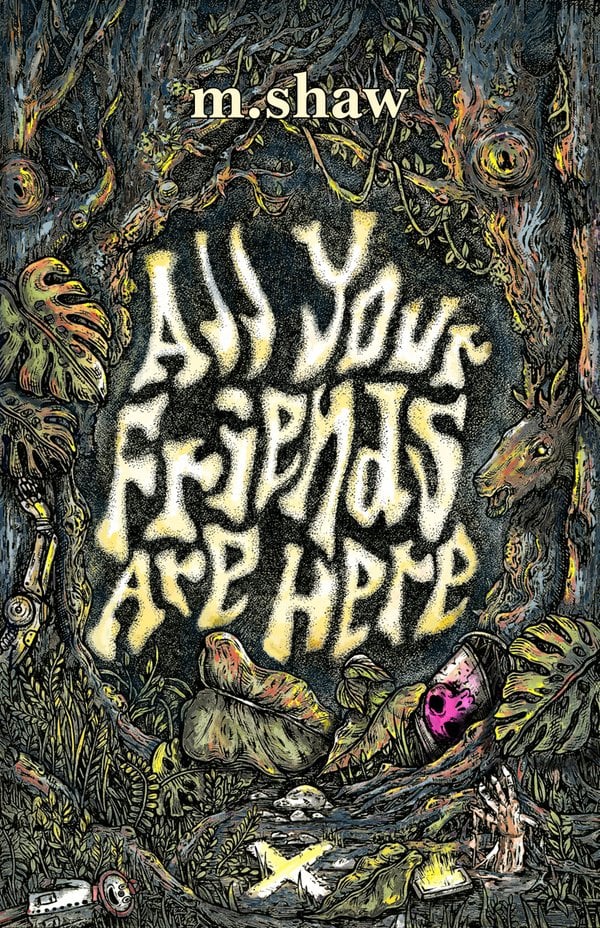
One might wonder if M. Shaw’s All Your Friends Are Here is classified as New Weird because, as a collection, it has too many discordant pieces to fully fit anywhere else, even if individual stories might earn themselves a more standard genre placement.
It’s got horror/eco-horror/body-horror (“The Only Friend You Ever Need,” “Go with the Flow,” “The Cure for Loneliness”) which maybe skews towards comic horror, a sub-genre having its moment in the sun. It’s got science fiction (“My Dad Bought a Space Shuttle,” “Ready Player (N+1)”), though these, wonderfully, are really transfemme bildungsromans with some satirical science fiction wrappings. It’s got transgressive lit (“The Motorist,” “Roots in the Ground,” “Man vs Bomb”) which I call transgressive instead of body horror because they involve sex and genital mutilation of one kind or another, and according to a poorly argued 2023 GQ review of Bret Easton Ellis’s The Shards that I’m still mad about, it’s not transgressive unless a penis gets disfigured.
I think we can at least agree that any collection with 26 separate content warnings—one of which I had to look up in the dictionary (dendrophilia: sexual arousal from trees)—is clearly aiming for transgression of some kind, though a bit tongue-in-cheekily.
The real question(s) isn’t how to categorize the stories. It’s whether they’re any good. Are they a pleasure to read? Are they befuddling and charming and funny and heartfelt? Do they make you want to read more, as in both more of each individual story and more stories like them? And, also, least and most importantly: are they weird? And the answer is: yes. Yes, they are good, and yes, they are weird.
In “The Only Friend You Ever Need” the narrator manages to draw the attention of a malak, one of the world’s many murderous, ineffable creatures, one per city. There aren’t really any rules or logic or worldbuilding. It just is what it is. I’d have been happy with a novel-length version of this story, or, perhaps, an old-school 22-episodes-a-season television series.
“I worked out a system: every time I wanted to check the back seat, instead of doing that, I made my peace with God.”
In “The Cure for Loneliness,” a woman slowly turns into a plant (which, as we know from Han Kang’s The Vegetarian, is a topic worthy of The Nobel Prize). It’s one of the scarier stories in the collection, though that’s because as a vegan I find the concept of possibly-sentient plants particularly terrifying. Like all multi-dimensional stories, this story of toxic plants is interwoven with the story of a toxic relationship, and it gets you rooting for the roots.
“Not to blame you for anything, but hearing this made it a lot easier to believe, in the ensuing months, that I was conducting a cute little experiment and not ceding the entire ecosystem of my life to something I still barely understand.”
And, of course, there’s “Roots In The Ground,” which deserves mentioning not just because it’s the first story in the collection, and not just because it does a terrific job introducing you to the whole book’s themes of the natural world gone wrong and grief and sexual deviation and self-sacrifice through numbness, but also because it’s the story that needs a content warning for dendrophilia.
“How she had doubled back and passed us without our noticing was beyond me, but it was either that or there were multiple tree orgies going on that night, which I didn’t want to entertain.”
Is it a perfect collection? There are, admittedly, a few stories where the satire is a little too on-the-nose (“The Apology”) or a kind of wry-but-dry recitation of purpose (“One Long Staircase, Just Going Up”). Stories like that can help decode the rest of the collection. They give you a less layered look into the author’s thematic goals (so we’re complaining about the billionaire-led end-stage-capitalism dystopia?) which you can then apply as a template to their more obfuscated peers. Plus, there’s no such thing as a perfect collection, except, perhaps, according to some literary scholars, Joyce’s Dubliners (to bring back our Irish modernists), though those same scholars also call the final entry in that collection, “The Dead,” the best short story ever written, which implies the others are not the best short story ever written. So how could it be perfect?
What all the best stories in this collection have in common is voice. It’s the winking sardonicism of college-educated-but-stuck-in-a-dead-end-job, the liminal space of dying suburbia, a genuine feel that the narrator is chatting with you even as the details swerve from bizarre to bizarrer. Voice, of course, is one way of delivering an allegiance to prose over plot, and this literary elevation is why these stories sit on the New Weird shelf rather than any of the other genres or sub-genres they actually are. Voice like this holds the strangest stories together, because even when logic fails, you’re being talked through it by someone to whom you want to listen.
Gewgaws*
🐟
*Gewgaws are like Michelin stars, but better cause they're for short fiction. They are determined by the editor with input from the reviewer.
1 is great; 2 is exceptional; 3 is perfect.
 M Shaw and Echo Echo