
🧩 Jigsaw
Maureen Bowden
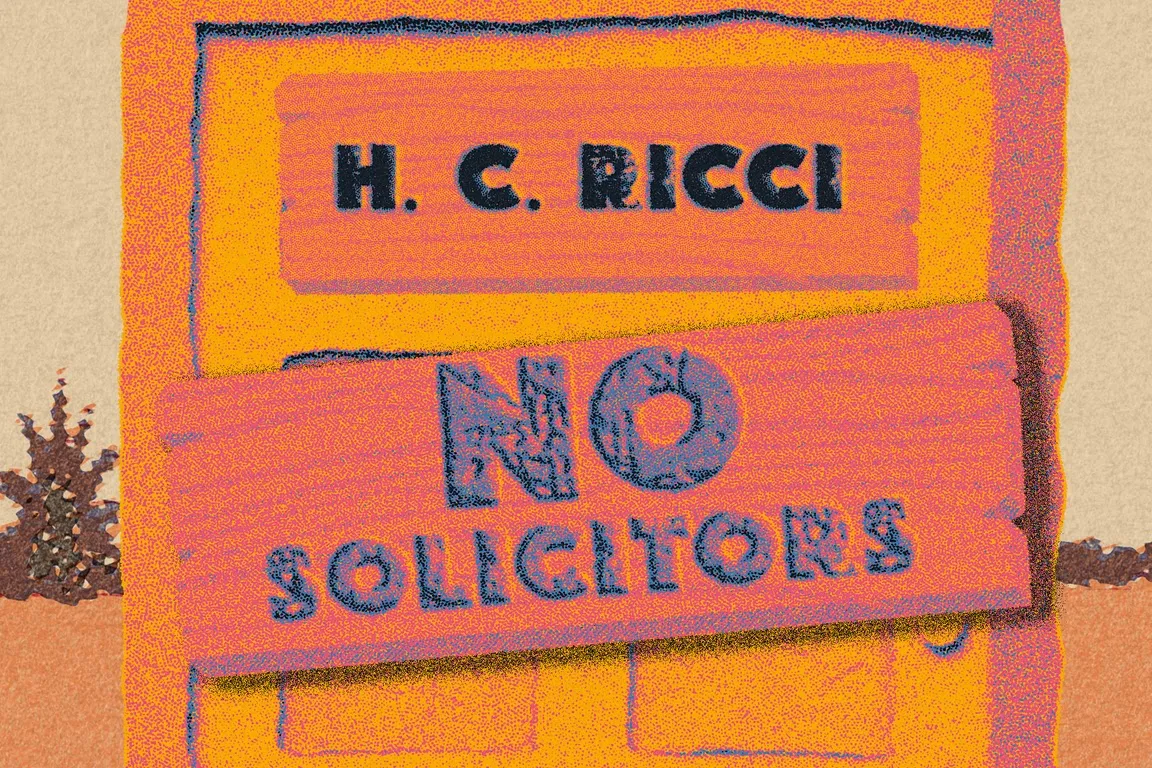
H. C. Ricci


Chazz Martin was a former New York City ad man, twice divorced, who’d spent his entire adult life living in Manhattan’s Upper East Side. To those who knew him, he was the epitome of a New York socialite—erudite, debonair, and ruthlessly ambitious—which is why it came as a surprise when he decided to quit the ad game, sell all his possessions, and move cross country to live in an adobe shack in the badlands of the Mojave Desert.
Chazz bought a two-story house with dirt floors, which once belonged to a famous artist who’d moved to the desert after the Great War in an attempt to recover his lost sanity. His only neighbors were a 300-acre date farm to the west and the sprawling Air Force base to the east.
The first year, Chazz left a handful of times to visit friends back East, but those visits soon grew few and far between. He spent his free time wandering the empty desert, making long treks to the shanty towns of the Salton Sea and to the desolate valleys of Indian Canyon. He reveled in the stillness, embracing the solitude which he had craved his entire life. And despite a successful career as a New York ad executive, Chazz would've died happy if he never saw another suit or heard another sales pitch for as long as he lived. Which is why he nailed a sign to his door which read “NO SOLICITORS” in blocky white lettering.
One October, a freeze fell upon the Mojave Desert that was more bitter than any cold spell in living memory. It felt as if the atmosphere had grown thin and the cold emptiness of space filled the desert. The roads were closed and the citizens of that almost uninhabited valley where Chazz Martin lived were ordered to shelter in place in response to an “unspecified disturbance” at the local Air Force base. Chazz bunkered down in his living room with a bag of pretzels and a case of cold beer while college ball played on the television. He never followed sports closely, but the sound of it playing in the background provided a sense of comfort on cold, lonely evenings. The warm glow of the television brought a touch of color to the shadowy adobe and the game’s commentary drowned out the creaking and rattling of the ancient house.
As he leaned back in his recliner, the doorbell rang. Dinnnng. Chazz ignored it. Then a minute later it rang again. Dinnnng. “Who the hell could that be?!” Dinnnng. “I’m coming! I’m coming!” Dinnnng. Chazz ripped the door open.
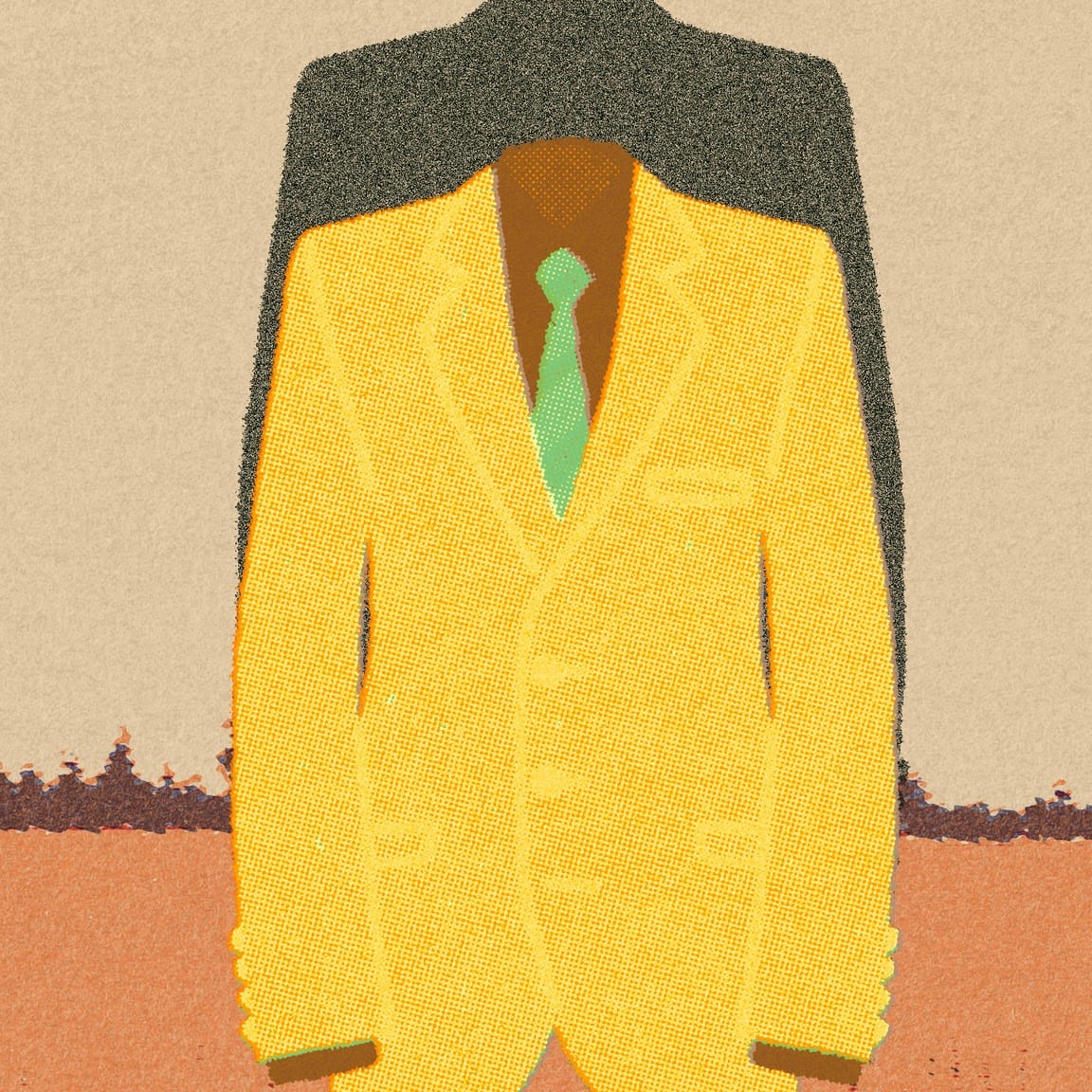
“Good evening sir. I was hoping to tell you a story.” The man on his doorstep was shorter than Chazz and wore a yellow suit. His pale face shined bright as the new moon. He had high cheekbones, a thin mustache, and dark hair which he slicked straight back. His smile looked plastic and rehearsed, like something he wore, rather than something he felt.
Chazz pointed to the sign which read “NO SOLICITORS” and slammed the door in the stranger’s face.
Less than two minutes later—just enough time to make himself comfortable—the doorbell rang again. Dinnnng. Chazz bolted to the door.
“What don’t you understand about ‘no solicitors'? I don’t want to buy whatever it is you’re selling. Now leave me alone!” But as he was about to slam the door again, an inexplicable urge steadied his hand.
“But sir, I am not trying to sell you anything. I just want to tell you a story.” The man’s dummy-like features hardly moved as he spoke.
“Save it! I used to be in the ad game and can spot a sales pitch from a mile away.”
“But sir I journeyed such a long way to tell you my story and I really think it may be of interest to you.” The man’s face looked hard and plastic.
“I don’t care if you’re with the Church, the Shriners, or the goddamn Girl Scouts of America. I don’t wanna hear it!”
“If, after I’ve told my story you still want me to go, I’ll be on my way. But please sir, it is a very good story.”
Chazz glanced at his watch. “You’ve got fifteen minutes. That’s ten minutes more than you should need. At Wieden Kennedy I gave my writers just three sentences to sell me, but I’m going to give you fifteen minutes to pitch whatever the hell it is you’re trying to sell and not a second more. Then I’m going back inside to watch college football and drink beer. And if I hear one more ring or a knock on my door I’ll be holding a shotgun the next time I answer. Capiche?”
“Oh thank you sir! I promise you won’t be disappointed.”
Chazz stood gripping the door knob with one hand and checking his watch with the other as the stranger in the yellow suit told him strange tales from his homeland. He spoke of Cassilda’s Song and the beauty of Lake Hali. He described—almost poetically—the way cloud waves broke along the shore as twin suns set behind the lake. He talked at length about Camilla’s masquerade and the man in the Pallid Mask. But it wasn’t until he finally mentioned grim Carcosa that Chazz actually began to actually hear what the stranger was saying.
Chazz hung on every word as the man in the yellow suit described the dread city. He spoke of dark monoliths rising to meet black stars and a labyrinth of unlit alleyways with each path leading to the secret shrines of the Outer Gods, who lurk at the edges of space and time.
The stranger’s words possessed a strange melody—beautiful and terrifying. He spoke of the Imperial Dynasty of America, and finally the King in Yellow.
The stranger seemed taller than he had been a moment before. Slowly, the folds in his yellow suit unfurled into tattered robes, which grew and grew until they flapped chaotically in the midnight air. His face too began to shift in the moonlight. Chazz noticed a crease around the edges where it appeared to separate from the skin, like cheap plastic.
“Take off that mask! You’re freaking me out.”
“I have no mask.”
“No mask?”
An appendage, not an arm, reached into his robes and pulled out a folded piece of yellow parchment paper, which it delicately opened to reveal the Yellow Sign. Seeing the sign, Chazz Martin ceased to exist. Where he had once stood there was now only a bag of flesh and bones with the appearance of Chazz Martin, but whose body and soul now belonged to the King in Yellow.