🍽️ The Retro Diner
Lisa Taylor
by Jim Best

The voices are back.
They whisper in the distance. Tinny-sounding words he can’t yet make out, like a record played on the wrong speed in another room. He decides he’s not hearing them. The doctors have told him that one day, when he is well enough, he can leave this place. Well people don’t hear voices, so he isn’t hearing them either. He decides to close his eyes and go back to sleep; they will be gone when he wakes up again.
Back to sleep? Had I been sleeping?
He isn’t sure. He’s in his room and in his bed, but he can’t remember going to sleep. That’s no surprise, though. The medicine and shocks make remembering hard. He knows he used to see memories all in a line, front to back, like a movie. Now they are more like pictures all mixed up in a box, with gaps in between. He hopes that someday he’ll get them in the correct order again. In the meantime, he needs the medicine and the shocks to make him well so he can leave when he is ready.
What can I remember? Looking around his room’s bare, blue-green walls and trying to hold off a rising sense of panic. The voices are a little louder now and coming in a little clearer. In the chatter, he can make out a few of the words.
Criminally insane… hopeless… poor things…
His eyes fixate on a spot beside the door and he sees a face in a pattern of grime. He knows that face. He has seen it before—many times. It anchors him. I am here and here is a hospital. How long have I been here?
That is a hard one. I just woke up, so at least one night. But it must be longer than that because he knows he’s had lots of shocks and seen that face on the wall many times before. So, what then? Too hard, come back to it. Try another. Why am I here?
That was easy. It’s a hospital and sick people stay in hospitals, so he must be sick. Only, he knew this wasn’t a sanatorium like Uncle Regis went to, or a hospital for people in pain, like they took Loraine to after the accident. This was a hospital for people who had sick heads. Like people who hear voices.
Yes, but he doesn’t hear them anymore. He used to. It got bad after the things he saw and did in war. Then Loraine had her accident and things got all fuzzy. Her head had twisted all the way around; her eyes open, but unseeing, stared up at him from the bottom of the stairs. And he had heard a voice then. It was screaming. And the screams sounded like laughter. But that was before coming here. They were fixing him here.
Anyone in here..? Can you hear us?
“They aren’t there,” he whispers to himself and flinches at the sound of his voice in the sterile silence. They are, though. Getting louder and closer with every passing moment. They chattered and chattered their nonsense—laughing, crying, gasping.
He waits for something to happen. He isn’t hungry, but wouldn’t mind the orderly coming in with food, just to see someone, to talk to someone. The voices talk to each other, but not to him. Not really. They sometimes ask things, and he thinks they might be asking him, but he never answers. Crazy people talk to the voices in their heads and he is getting better. Instead, he stares at the face in the wall, feeling its dirty eyes on him, feeling seen by them. It comforts him.
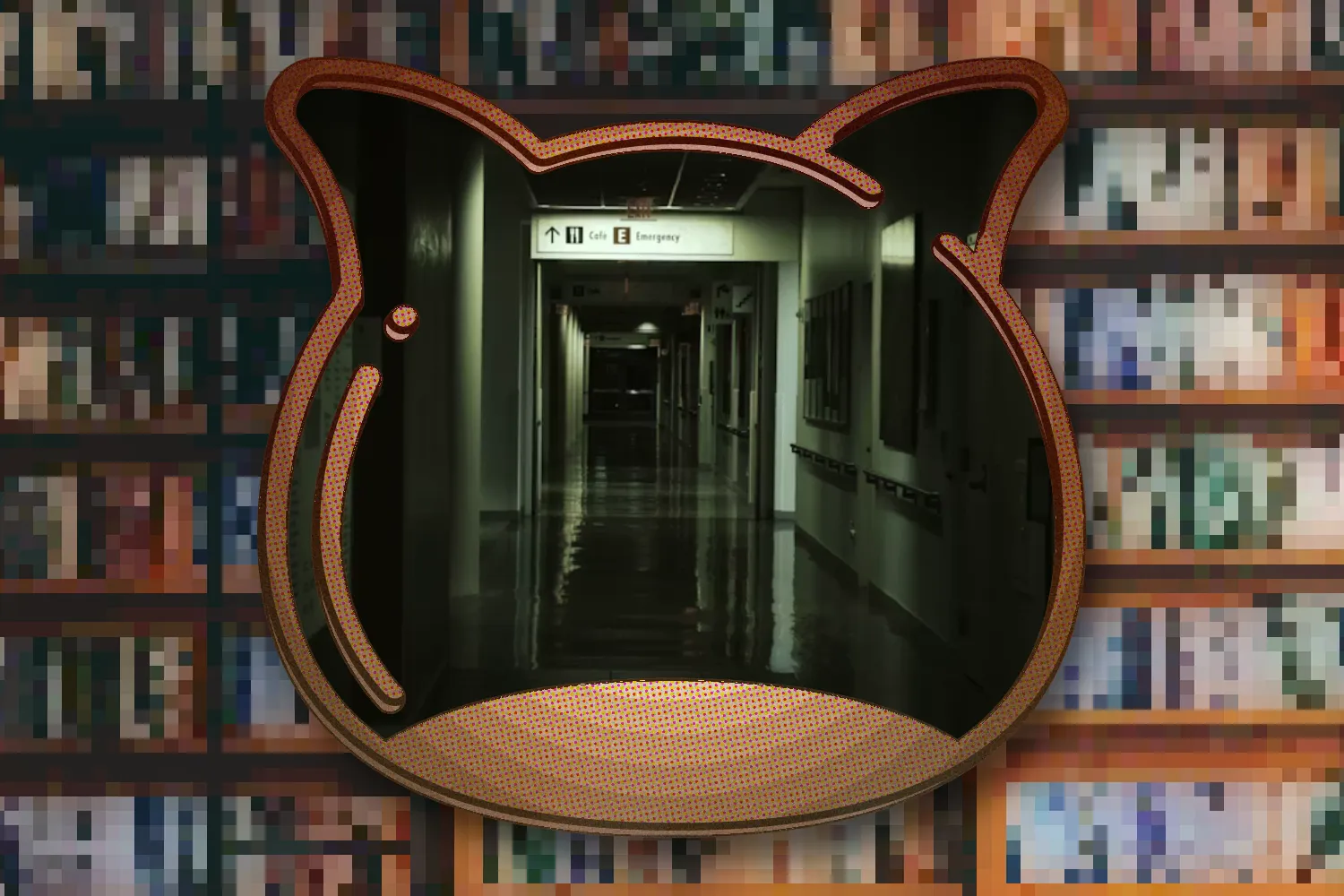
When he can no longer stand the stillness, he springs up, and darts to the door. Pressing his face to the mesh-filled observation slit. He slides his eyes along the hallway. Where there should be wandering hordes of other sick men like himself, there is nothing except linoleum walls and cement floors caked with dirt and dust, bathed in shadow. Moonlight glows through the barred window. Instead of the thunderous roll of creaky gurneys and shrieks of the insane, there is silence. Silence, and:
Head upstairs to the rooms… stay close together… most active patients…
“Who is that?” He shouts before he knows he is going to do it. He claps a hand to his mouth, cringing in terror. Shouting is against the rules. Worse, he is talking to the figments of his imagination. He can’t do that if he wants to get well.
He closes his eyes. Braced against the door. Waiting for the rush of footfalls and men carrying the coat, sticks, and a needle.
There is shuffling of feet on stairs that groan under the oppression of time and weight. Hear that? Maybe... let’s see… stay together…
Tears trickle down his cheeks, making him think of Loraine. The hot tears on his face and the red—
“Please? Can someone please help me? I need…” What did he need? “I need to see the Doctor!”
They say he killed his… incurable psychotic…
“Are you real? Damnit, if you are, answer me!”
He pounds a fist against the sturdy, always locked, metal door, sending a familiar pain through his arm. It swings open in a slow and smooth arc, sighing on its hinges as it does. He thinks someone is gonna get fired for this. You couldn’t just leave doors unlocked in this place. Then the crazy people could all just leave whenever they wanted, and they were not supposed to leave until they were well.
He knows this so he does not move at first. He stares in confusion at the open door that leads to the empty hallway. Centuries pass as he stares, his heart rattling against his rib cage. I can’t leave. I am not supposed to wander the halls by myself. I know that. Everyone knows that.
From somewhere in the distance, …close together now… lots of activity…
“Hello? Can anyone hear me? Please, I need to talk to the doctor! I’m not well, not well at all!”
Silence follows, and the silence is worse than the voices. Someone should be here. Someone should come for him. Hospitals are never this quiet with hallways this dark. Where are his keepers?
They left me. Ice pours into his blood. They all just left me. He gets a flash of one of those jumbled pictures. He is standing in a playground, staring at an empty park bench. Grandpa was supposed to be there, watching him. Later, when he is found in a blind panic, and the old man is stroking his back soothingly, he will learn that Grandpa just went to get a drink of water, but he doesn’t know that now. He just knows he is a little boy looking up from the sandbox, expecting to see his grown-up’s face, and now there is nothing there. He heard them, right? The voices. For the first time, he heard them whispering to him, and what they said terrified him. He’s been forgotten.
Back in the hallway, fear overrides obedience, and he starts at a half jog, fighting the urge to gallop. They’ll be here. Someone. Anyone. A nurse, a doctor, a janitor. They’ll see me and ask why I am out of my room, and I’ll tell them the truth, that someone left my door open and I got scared. I think I’m hearing things.
All this passes through his brain before he is even over the threshold. These thoughts are dashed as he looks down the long, bare, concrete hall and sees only absence. Dust bunnies clutter the corners. A rusted wheelchair sits riderless in garish moonlight by the window, like a ghost contemplating the night sky. Gone is the sterile hospital smell, replaced with rot and mildew. On the wall, paint that is old and faint and coated in a layer of grime, some wit has scribbled, I’M NOT CRAZY! LET ME OUT!
A thought creeps into his mind, one that can not be exorcized: when was the last time he saw anyone? Can he remember?
Of course I can, yesterday. Everything was right yesterday. I had my breakfast and my lunch and took my pills and had my session with the doctor, had my dinner, and went to bed. And this place was alright then. I was getting well. I was getting ready to leave one day. I remember that.
Right, but when was yesterday exactly?
Now he runs. He starts down the hall, crazed with panic as he begins to scream. “Help! Please! For God’s sake, somebody! Please help me!”
The hallway stretches long, narrow, straight (has it always been this long?), and in it, there is nothing. Until again there are the voices, and now, shapes. Shapes moving in the dark. He stops running and stares, held still by the same terror that makes deer stare down oncoming cars.
Human-shaped shadows walking in the darkness work their way towards him. Devoid of features, shuffling slowly, unhurried, and talking their nonsense in voices that sound like echoes. I swear it’s colder up here… Whoa, that’s a big spike… see anything..?
Opening his mouth to try to call out, he finds the words choke off in his throat. He is shaking hard enough to be unsteady on his feet and tries again. “Hello? Please… I’m alone… can you help me?”
Hear something..? Turn on the lights… anyone here?
Lights pour out of the murk and slice through the shadows; now he feels more fear than ever. Inexplicably, his first thought is Oh my god, they’ll see me! Followed by, they won’t! They won’t!
Screaming, he turns and runs. Despite this being impossible, the door to his room is just a few feet ahead. His vision is narrow. He is running to keep from fainting now, and as he throws himself back inside, it takes every reserve of strength left in him to slam his door closed. Collapsing against it, he sits, shaking, clutching his knees. His eyes scan the wall in desperation until at last, they find the face, and he is seen. It will all be alright, he thinks, just have to wait for someone to come. They’ll help me get well. Then I can leave. He rests his face against the tops of his legs and closes his eyes.
“I swear it’s colder up here,” Rick says, looking down the long concrete and linoleum hallways lined with patients’ rooms. Decades of neglect and abandonment are evident everywhere. Graffitied walls, rusted equipment, dirt, and dust-crusted floors. Suddenly, next to him, Pete’s equipment crackles and whines.
“Whoa!” Pete exclaims, “That’s a big spike!” He looks up, “you see anything down there?”
“What was that?” Greg says, lowering his camera.
“What?”
“I dunno… sounded like a voice. Did you hear something?”
Rick shakes his head. “Are you screwing with me?”
“I heard it too,” says Pete.
“Turn your flashlights on, there might be a vagrant or something here,” Rick instructs, shining the light down the hallway. “Is there anyone here? We don’t want to bother you, just doing a little late-night ghost hunting.”
Nothing moves. Then—
“There,” Greg says, “you hear it? Sounds kinda like, I dunno, a whistle or—”
“A scream?” Rick finishes.
The beams of light cut through the dark in long, slow arcs, searching. Then a new sound interrupts them—a long, slow screech. Ancient hinges on a door that has sat open for untold years cry out in distress. The three watch as the door, moved by an unseen hand, clicks closed.

This week’s ad slot was purchased by friend of Foofaraw, Evan Passero, in support of DIFFA Dallas—providing critical financial support to North Texas AIDS service organizations that offer direct care to adults, families, and children living with or impacted by HIV/AIDS.
Foofaraw will match up to $300 in donations to DIFFA Dallas, Elevated Access, and Denton Community Food Center through the remainder of 2025.