
🧹 Escape Algorithm
B. Morris Allen
Tyler Lee

“Theron says we should paint the ghost train.”
The words spin out of Gabe’s crowded lungs like smoky spider-silk—faint, impossible threads hanging in the air. All but imperceptible until you walk into them. I mash the pause button on my controller and turn toward Gabe, Yoshi’s kart frozen mid-drift on the flickering TV.
“Wait, what?”
Gabe cranes his neck and exhales a web of bong smoke into the unfinished basement ceiling, wisps twisting around exposed pipes, jittery aluminum ducts, splinter-ridden crossbeams. The haze drapes itself around the bare light bulb, bending the white rays an almost gunmetal grey. Gabe hacks like a cowboy about to die in an old Western, then clears his throat with a garden shovel and work gloves.
“Theron, that new kid. The big-ass twelfth grader from Hamilton,” Gabe says, the silk-threads of his voice now wrapped in blood and sinew again. “I told him we tag. He says we should paint the ghost train. Like a big end-to-end, all three of us.”
Gabe pulls the stem from the bong, and taps it out against the ashtray like Morse code. The tape deck on the shelf clicks as it hits the end of the cassette, then spins back to life as it flips sides and reverses direction. Xzibit’s gravel voice growls through the speakers.
“What do you think?” Gabe asks.
“How the fuck are we supposed to piece the ghost train, Gabe?”
“Fucked if I know. We were skating on Main, and he brought it up. Figures we can do it, though, somehow. You going to school tomorrow? Could ask him about it.”
The Vancouver Grizzlies poster on the front wall shakes harder—too hard to be caused by the speakers—plastic frame rattling against the particleboard walls. Two spears of white light slice in through the storm windows, broad blades dancing off the aluminum ducts, softening in the lingering smoke. I bounce from the sagging, corduroy couch, dart over to the entertainment stand, and ratchet the volume dial all the way down, revealing the rumble of a semi-truck idling in the front drive.
“Fuck, fuck, fuck.” I scoop a can of aerosol air freshener from under my bed and pin the button down so hard the tip of my index finger tingles and turns red. The can hisses copperhead tongues as my body spins and pinballs, submerging the basement in a thick blanket of Pine Barren Petrichor or Spring Sunrise Redolence or what-the-fuck-ever IGA had on special this week.
“Bro, why is your dad home?” Gabe asks. “I thought you said he was on a long-haul?”
“He is. Wasn’t supposed to be home until Monday night.”
“Uhh, Jake—it is Monday night.”
I have a math test on Monday—had, a math test—double-fuck. “Gabe, could you help out at least? I’m about to be in serious shit here.” Gabe picks the bong off the coffee table and carries it to the far corner—behind the stairwell, next to the washer and dryer—then empties the water into the rusty iron floor drain. He retrieves a shoebox from under the couch—a battered-and-creased brown-and-orange Nike box, papered with skate stickers and Sharpie tags—tucks the bong, stem, and ashtray inside, and then slides the box back under the couch.
“Jake,” Gabe says—voice like lake ice in early April—“I think I might clear out… It’s just, your dad is kind of… You get it, right?”
“Yeah, don’t worry about it bro. All good. Before you go, how does it smell in here now?”
Gabe inhales a cubic kilometer of aerosol perfume and sputters out a cough. “Uhh, smells like an anti-depressant commercial threw up in our Home Ec room.”
I curl a smile. Gabe’s eyes flash like a panther sniffing splashy, iron-rich blood on the breeze. “Smells like all the world’s funeral flowers on the day disco died.”
Laughter cracks out of me like embers floating up from a dying campfire. “That doesn’t even make sense, dude.”
Gabe turns his head, closes his eyes, and breathes in again. “It smells like a summer sleepaway camp where the counsellors make the kids braid friendship bracelets at gunpoint.”
The campfire erupts—detonates, really. In between laughs, my lungs claw at the sky to regain their balance, dizzy-drunk on a cocktail of stale smoke, synthetic springtime, and domesticated basement dust. Gabe stares at me, “What? What’s so funny?” his mock-Pesci pupil-twitch vibrates his blazed-red sclerae, a micron-thick layer of laughter-tears clinging like skin to his eyeballs. It all makes me think of simmering cream of tomato soup.
Then, the cold rattle of a brass doorknob, coffin-creak of steel hinges. A chill breeze flows down the stairs, floods into the room, extinguishes our hearth. Any lingering crackle of light or laughter turns first-snowfall-silent. The quiet is only broken by my father, his voice tumbling down the staircase like shards of avalanche ice.
“Jake, upstairs. Now. I won’t ask twice.”
Gabe stares at me, eyes still wet, but now frosted over. “It’s okay,” I say, “take off through the side door after I go up. I’ll see you at school tomorrow.”
“Yeah,” Gabe says, “school tomorrow. Cool.”
I’m at school an hour before first bell, face down in my black book at a cafeteria table, silver Sharpie in hand. My fingers won’t follow my eyes, though. Skin tough and red from the ride to school, from holding my handlebars stiff against highway winds and truck-kicked gravel, knuckles and fingertips still tingling with the October morning cold. The marker tip doesn’t glide today, it wobbles—film-reel judders along every line edge. A rat bastard’s broken polygraph. I hear Gabe and Theron behind me, talking as they approach the table.
“Jakey, figured you were cutting again today. I heard Gabe clued you in to the idea,” Theron says, sliding a plastic chair out from under the table and sitting down. “Madman stuff, just imagine it—Jesus Christ bro, what the hell happened to you?”
Theron locks both his eyes on just my left one—deep purple and swollen half-shut. He stares at me like I’m a half-developed Polaroid. “It’s no big deal,” I say, “I just racked out on my board last night.”
Gabe looks at me, then Theron, then back at me. “Yeah, it was crazy bro,” Gabe says, “you should have seen it. Jake ollied that four-set at the post office. Almost landed it, too, but then he went face-first into the planter box.” Thank you, Gabe.
“Badass,” Theron says. “You okay?”
I shrug my shoulders. “Been through worse.” I had.
“Alright, well, try to keep all your limbs attached, you’re going to need them when we piece the ghost train.”
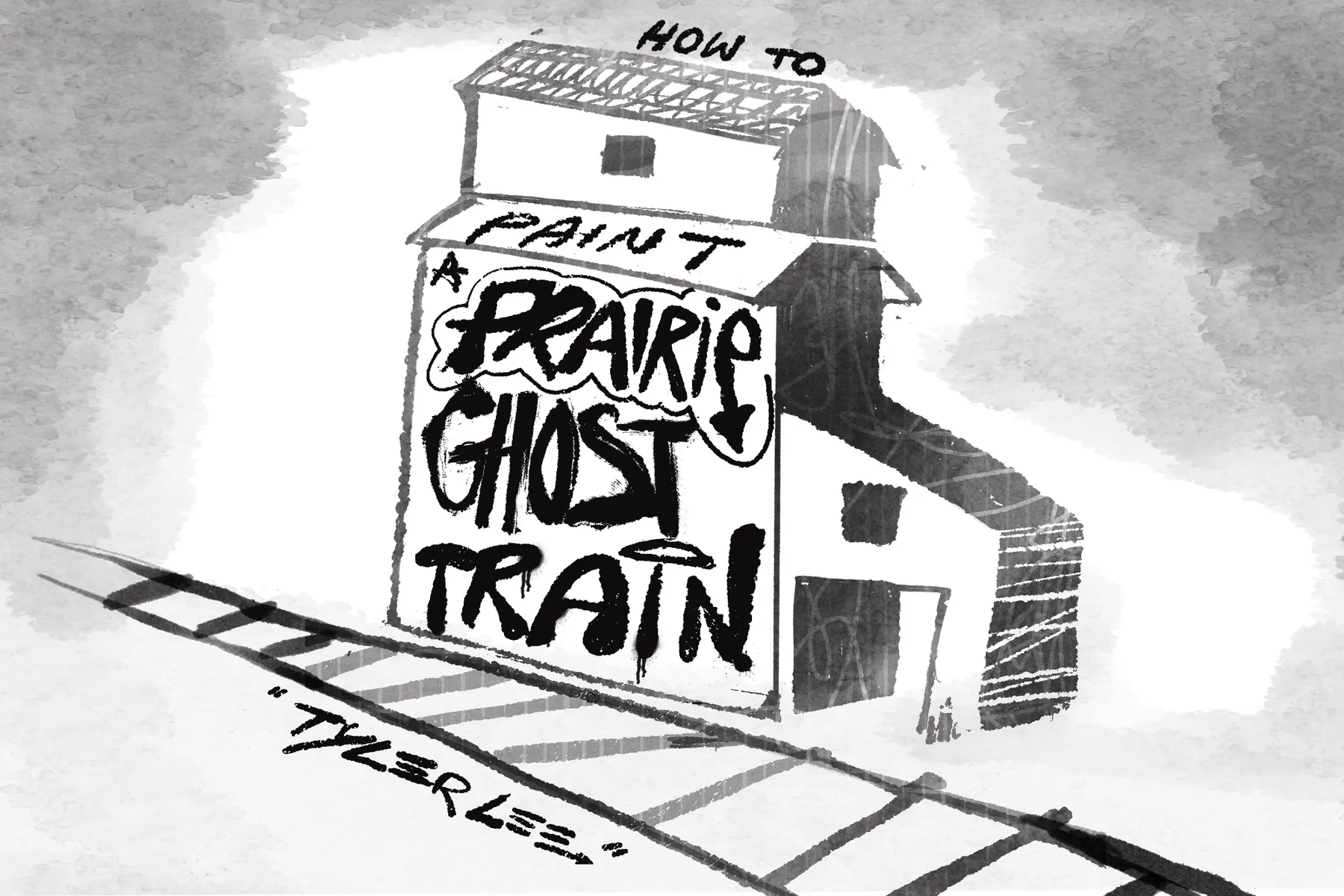
There’s a vacant lot a little ways out of Chapel Head—the town we live in—where the old Saskatchewan Wheat Pool elevator used to be. The rest of the train line’s been ripped out for years now, but for some reason there’s still eighty or so meters of track in the ground there, weeds and prairie grass swallowing it back into the dirt. Every Wednesday night, a ghost train moves across that stretch of track. Engine first, then freights, caboose—just flickers into existence at one end of the track, flickers out at the other. A couple cars at a time, like watching a movie through a keyhole.
I flip my sketchbook shut and bury my tender hands in the front pocket of my paint-stained bunnyhug. “How are we supposed to tag a ghost train, Theron? It’s a ghost train—it’s right there in the name.”
“I was out there last week,” Theron says, “and the thing is, I pitched a bunch of rocks at it while it rolled past, and they clanked right off the side. Chucked an empty Pil bottle at it, and it smashed. Might be all glowing and spectral-looking or whatever, but that son-bitch is solid metal. Paint’ll stick to metal.”
The cafeteria gradually fills up. Some of the hockey-hairs and wrangler-shirts eyeball my swollen face, smirking in my peripheral, laughing at the precise edge of earshot. “Alright, so the train is real, but we still can’t piece it, because it doesn’t fucking stop. How fast do you think we paint?”
Gabe pipes up. “Okay, well do you remember Michelle? Corey Henderson’s cousin from the city?”
“That goth chick who threw up Fireball and Fresca all over you at the lake back in August?”
“Bro, she’s not a ‘goth chick,’ she’s a straight-up, no-bullshit witch. She’s got potions and crystals—”
“You mean rocks?”
“Crystals, and tomes—”
“Books?”
“Dude, just shut up for like five seconds, please. I’m telling you—she knows her stuff.”
I shrug my shoulders and tilt my head down apologetically. “Sorry, I’ll stop.”
“Anyway… after I went home last night, I was thinking about the train again. I brought ‘Chelle to check it out back in the summer and she said something cool. She said ghosts usually haunt places, right? Like Katie’s great grandma at the old diner, Mr. Smith at the baseball diamond, that guy who plays banjo at the old dance hall. They’re stuck—fixed—like a tree. Rooted to the ground. They can’t leave where they’re at because something holds them there, some kind of purpose. That’s why the train is weird—a ghost that never stops moving. What’s its purpose?”
The cafeteria noise grows—broken snippets of conversation, shoes squeaking on linoleum. A flinch snaps through my body as an empty, balled-up Doritos bag—Cool Ranch, by the look of it—flies past my shoulder, skips across our table-top, and tumbles to the floor, eliciting a round of deep, clustered laughter from somewhere behind me. Theron stabs a glance in the direction of the noise, and the laughter quickly subsides.
“Holy shit,” I say, “I actually might have an idea.”
My earlobes shiver as the bell rings. I gather up my books and zip them into my bag as we talk. “Theron, do you have your truck here today?”
“Damn straight, yup.”
The Principal glares lasers at us through his horn-rimmed glasses. “Alright, let’s meet up out front after school.”
The “No Trespassing” sign is sun-faded, fence posts splintered and split, chicken-wire rusted from years of rain. I squeeze the bolt cutters, and the gate chain splits with a cracking noise, the padlocked end falling to the ground, kicking up a whirl of dust. I lead the truck up a rough, dirt path, overgrown with prairie grass, past a decaying farmhouse with boarded windows, a rusting tractor, and the footprint of a collapsed barn. After a careful descent down rough terrain—the hint of depth that passes for a valley in central Saskatchewan—I signal Theron to stop the engine at the edge of my grandfather’s jungle—a dense grove of impossibly tall, twisted trees, thick brush, mosquitoes, and shadows. Theron and Gabe climb out of the truck.
“You sure we won’t get in trouble?” Gabe asks.
“Nah,” I reply. “We’re far enough from the highway that no one will see us, and nobody in the family’s been out here since grandpa died. Eight years now, I guess.”
“Alright Jakey, what are we doing out here?” Theron asks.
I lead the group into the dimness of the woods. “Don’t laugh at me, but when I was a kid, I was scared of ghosts—like, really scared of them. There weren’t so many around back then, you know? I wasn’t used to it.”
On our right, we pass a faded blue telephone booth leaning against the trunk of a tree. A branch stretched through the booth’s windows, and a bird’s nest sits, weight balanced between the rough bark of the branch and the cold, black steel of the phone box. A steel-wrapped cord dangles from the phone, but the receiver has been chewed off by some kind of animal. The hint of a ringing sound lingers in the air.
“My dad used to bring me up here a lot when I was little. Grandpa was already circling the drain by then, but he wouldn’t move to town. I can remember them arguing about it sometimes. Grandpa was a weird guy. Didn’t like throwing things away, didn’t like anything to go to waste. Said the world was getting wasteful—disposable. Stitch the pants, scrape the plate—typical old guy stuff, I guess, but he was...” I notice Theron looking at me. “It was just a big deal for him, that’s all.”
We walk past a pile of typewriters—scuffed vinyl shrouds on some, carriages exposed and rusting on others, some keys broken off, the symbols on others erased by wind, rain, and time. A gust knocks an acorn from an overhanging tree. As the acorn skitters down, rolling across the typewriters, their keys all swing into possessed motion. For a split-second, the jungle sounds like an old-fashioned press bullpen, typing blank memorandum at machine-gun speed.
“The farm scared the shit out of me. It’s not so much the ghosts—there were a couple ghosts out here back then, but not nearly as many as you’d think—it was more like...” a half-dozen glass milk bottles dangling from twine in a nearby tree jangle in the wind, cascading rays of refracted light across the ground. “Okay, Gabe—you remember that spring a couple years back where the school gym flooded and they had to dig the floors out and replace them?”
“Do I remember it? My jump shot still hasn’t recovered.” Gabe scoops a pinecone off the dirt, jab-steps, and then launches it toward a nearby gramophone lying in the dirt. The pinecone bounces off the edge of the brass horn; a few seconds of distorted jazz piano plays. Gabe flings his arms to the sky in a fit of mock-despair.
“Well, you remember how they moved the assemblies to the choir room while they fixed the gym? And it was crowded, and stuffy, and it took forever to get everyone in through that one little door?”
“And it was hot as balls!” Gabe sings in an exaggerated falsetto, stretching the last note out like a manic Mariah Carey.
“My class was right next to the choir room, so we had to go in first every week. As bad as it was when the room was full-up—sweaty, sticky, just sitting and stewing and inhaling everyone’s exhale—I swear to god it was worse when you first got in there, and the place was still empty. Worse sitting in the back corner, watching people filter their way in. Knowing that you can’t leave—there’s no way out, nowhere to go—and there’s still more coming.”
An old ox-wagon lies on its side, two wooden wheels buried deep in moss and dirt, the other two spinning rapidly, creaking against the axle. A grey field cat sleeps in the shade of the wagon’s cargo box. “Being at the farm was kind of like that, I guess. It wasn’t so much the ghosts who were up here, it was knowing how many more were on their way. I guess that’s everywhere, but I felt it more out here.”
We walk for a while in silence. We pass totems made of old wheat scythes, bound together by rawhide, with moss climbing their handles from the forest floor. Saskatoon trees growing out of empty ammunition crates like planter boxes, berries littering the ground around them, painting the earth purple. A receiving line of wooden mannequins dressed in olive drab army surplus. The rusting frame of a ‘40s Chrysler—wheels missing—with a tattered miniature Union Jack clinging to the radio antenna.
“I tried to run away one night and got lost in the woods.”
“You tried to run away? Why?” Theron’s voice pulls me back to my body—reminds me that he’s still here. I glance at him, then back at Gabe.
“Yeah, you know...” I stammer a little. I remember my sketchbook this morning—pen won’t follow my eyes; fingers won’t follow my brain. A bird calls in the distance and a gust rustles the leaves. I breathe again.
“It’s just my dad,” I say, “sometimes he...” my head tips forward, my voice rolls up my windpipe, falls through my jaw, and lands on the ground. The moss sucks it beneath, swallows it to the pit of the earth.
Theron rests one of his enormous hands on my shoulder. “Hey, don’t sweat it, Jakey. Parents fucking suck.” Even through my bunnyhug, his palm feels warm. The corner of my left eye tickles like a butterfly wing, but I rub it away with my index finger. Theron takes his hand back and steps a few feet away.
“Right, yeah,” I gather myself and speed up my pace, “fuck parents.”
“Fuck parents!” Gabe sings at the top of his lungs.
“I got lost in the woods, and it was getting darker out—pitch-black, almost. But then I saw light through the trees. Like a glowing blue light, out of nowhere.”
“Like the train,” says Theron.
“Yeah, just like the train. I was scared as fuck. But I didn’t know where else to go. So I followed the light, and it led me to this.” We round a thicket of brush and enter a slight clearing—a gap in the canopy wide enough to let sunlight through. The clearing is littered with piles of salvage wood—planks, beams, boards—most of them the same dirty-clay-red as the hundreds of abandoned barns and farmhouses around here. A few dots of grey can be made out in the red—fragments of letters, shapes, symbols.
“Wait, is this...” Gabe trails off as he asks the question.
“Yup, and that night, it was all glowing.”
It takes us the rest of the day and four trips in Theron’s truck. Digging through the planks, finding the right pieces, lugging them down the dark, sinuous trails through the forest. We unload the boards near the train track, hiding them in a dried-out ditch. On the last trip, we stop by the school, and I pick up my bike, lofting it on top of the boards in the back of Theron’s truck. It’s past midnight when we finish unloading.
“You sure you don’t want a ride home?” Theron asks.
“Nah,” I say, “I think I need the air.”
I roll past my house slowly. My dad’s rig is still in the drive. I pedal past the house, then to the end of the block. I turn left and then right, pulling to a stop at the ball diamond. I lock my bike to the backstop and climb down into the dugout, sprawling out on the cold bench with my book-bag tucked under my head. The ghost of Mr. Smith chants “hey batter batter, swing” from behind home plate, but I drift to sleep, his voice little more than crickets.
School spins past at a chipmunk-fast-forward. After, we drive four towns out to the closest Peavey Mart for paint, and then suck back some fries and drumsticks from Chester’s on the ride home—Theron’s treat—launching our stripped-bare bones out the window like missiles aimed at the kelly-green marker signs that dot the highway ditches. By the time we pick up Theron’s ladders, pull up to the train tracks, and drop the tailgate, the sun is already groundhog-digging down into the dusty horizon, and the October sky drips with the juice of bleeding wild berries.
“God damn.” Theron somehow speaks and whistles with the same breath. “Won’t lie, when Gabe told me you boys tag, I was shocked. Way out here in the middle-of-nowhere? Like, why?”
“And now?” I ask.
“Now I’m surprised anyone lives out here without painting.”
From there, it’s just a jigsaw puzzle. We drag the planks out of the ditch and start slotting them together—rough, battered edges, faded paint, splintered, and weathered. Our hands guide the work as much as our eyes do—palms finding corresponding grains and knots, fingers returning parts to a whole. The last streaks of colour leak out of the sky, but the Hunter’s moon hangs high, raining down arrows of perfect moonlight. Theron moves the truck a few times to keep the headlights on our work and, before long, the shape materializes. Weathered red boards in a flat plane, lined up on the ground. Not nearly a building, sure, but something much more than a sketch of one, too. Near the top, a few massive lines of white-grey print. Softly sloping, rounded letters, all capitals:
SASKATCHEWAN
POOL
ELEVATORS
NO.725
CHAPEL HEAD
We retreat to the other side of the tracks, Theron moving the truck to cast the headlights on our canvas. I feel the ghost train before I hear it, and I hear it before I see it—fine gravel and packed dirt twitching under my Chuck Taylor soles, then iron scraping iron, rails flexing between wheel and earth. The train flickers into existence, a luminous blue-and-white aura wrapping black, burgundy, and rust-brown iron. A tower of light climbs from our jigsaw-slab of salvage wood—volume, shape, dimension. The train slows, then stops. To our right and left, the track edges divide a pair of freight cars—half oil-and-metal, half cold October air—but in the middle, in front of us, sits a complete tanker car.
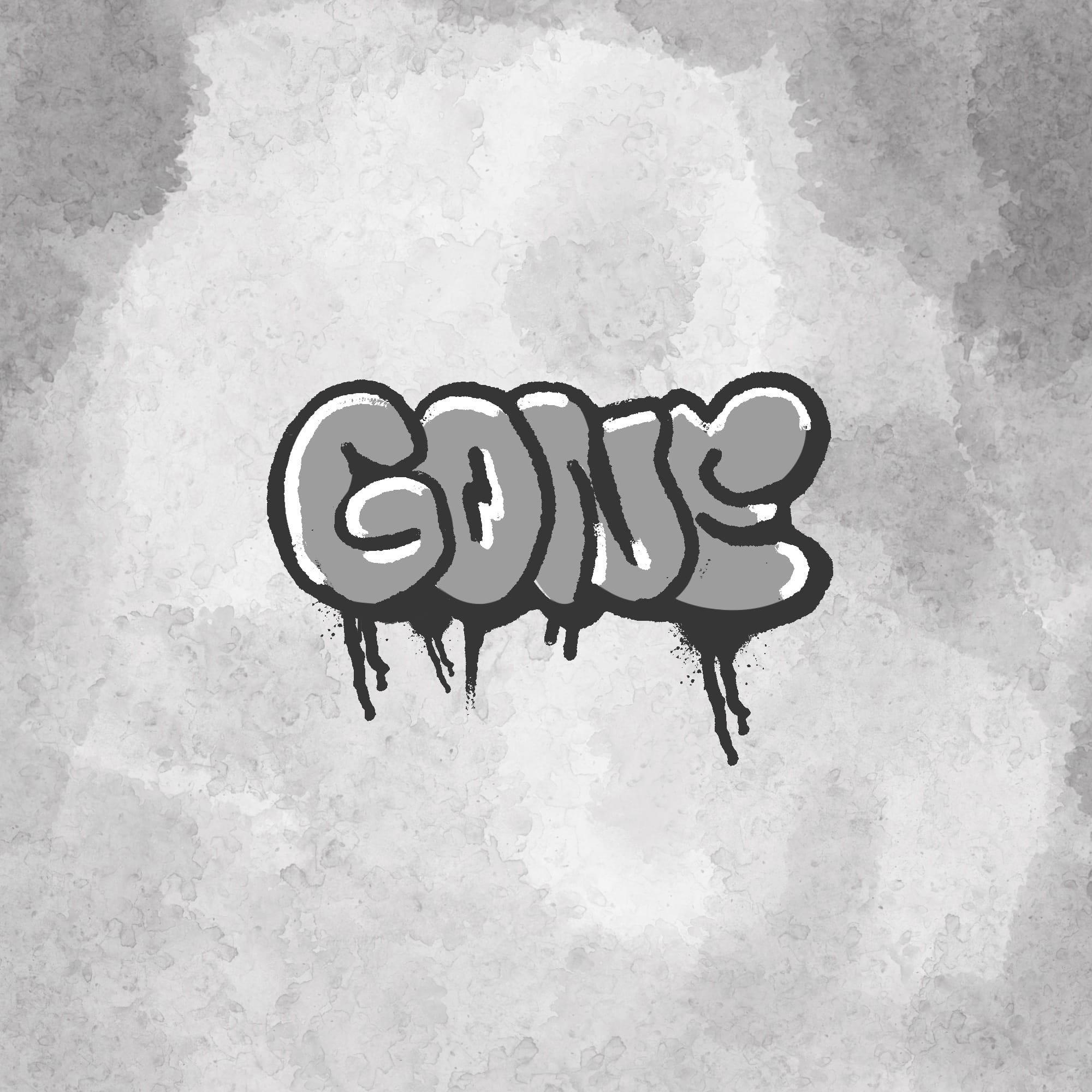
Theron takes the front third. He tags the name “THOR,” his caps barely containing the electricity in his barbarian hands, streams arcing like lightning from his sharp lines, letters twisting back around themselves like melting circuits. In the middle third, Gabe paints “GABE” because GABE is Gabe, and could never—should never—be anything else for an instant. Gabe paints with soup cans; warm and nourishing shapes, rotund bubble letters, like a liquid that expands to fill any bowl. I paint the back third. I used to paint “HERE” like frozen links of padlock chain—precise, geometric, unyielding. Tonight, I paint “GONE” like switchgrass and sunsets. Tonight, I paint without outlines, the colours and shapes blurring and bleeding into one another, a landscape seen through squinting eyes. Cans hiss and rattle, metal scrapes metal as we shift our ladders against the train car. Then, we finish.
Theron and I load the ladders and the rest of the paint back in the truck while Gabe snaps pictures, each flash punctuated by the clicking noise of advancing film. The train starts moving and then flickers out of existence, as the tower of light fades back to midnight black. We drag the pieces of the elevator back into the ditch and Theron hides them under camouflage hunting nets.
“That was a hell of a piece, boys.” Theron says.
“I’ll make you guys copies when I get the film developed.” Gabe says.
“That’s okay,” I say, “I don’t need them.”
I haul my bike out of Theron’s truck and pedal home. My dad’s rig is gone. I walk inside and find a note on the kitchen table: Jake, got a haul for Thunder Bay. Back Saturday. Don’t fuck anything up while I’m gone.
I stumble down the stairs and toss a tape in the deck—the new Outkast album Gabe dubbed for me on a cassette that’s been written and re-written a hundred times—then collapse into my bed. Hold On Be Strong plays: strings pluck, keys echo, and a distant, faded voice sings to me like a ghost through the speakers. The cassette reels rotate, clicking just a little bit at the same spot on every orbit.
The rhythm reminds me of a train on tracks, inching forward, slow but ceaseless.