🥣 Of Iron & Oatmeal
Michael Allen Rose

H. Marin

Val eased her banged-up, sputtering Hyundai Accent through the wrought iron gates of Lion’s Head Estate and up the winding hill. She could already feel the velvety, perfumed whisper of borrowed luxury on her skin.
The thought made her thirsty for something cold, acerbic. Just a shot to relax—to really enjoy the moment.
She took furtive sips from her water bottle until it passed.
The mansion looked ancient, its sandstone façade glimmering dull pearl in the fading light. As Val pulled into the wraparound front drive, the smell of rosehip poured in through her open windows. Lush, tended gardens adorned the front of the house like the pink and white buttercream peaks of a cake border. They had been freshly mulched, the neat front steps swept of leaves, the windows gleaming from a recent wash.
Val parked in front of the three-car garage and crawled out of the lemon she’d won in a poker game a few weeks back. She thought she’d be stuck in Louisiana forever after getting released on good behavior—a life sentence this time, like Iggy would have gotten; one of too-hot kitchens and the smell of over-seasoned crawfish, loud tourists and their louder children, simmering, writhing bayous, summer air that never really cooled, only held still—until the car fell in her lap. She’d left for home the next day. Not that she was sure she’d be welcome.
Val stretched her long brown legs in the warm autumn sun and whistled as the view from the top of Lion’s Head unfurled before her. The town of Almena lay spread out below, a checkerboard of brick red and clapboard brown, the Mississippi River a slash of glittering stone-blue on the horizon. Lion’s Head was so high up, she thought that, if she tried hard enough, she could taste the clouds—flavorless fluff that melted on her tongue, more like ice than spun sugar.
Next to the enormous oak slab of a front door sat a white stone pitcher, a sturdy, tiger-orange mum spilling over the sides. Per the instructions she’d copied down from the house-sitting ad, she tilted it carefully, grunting with its weight. A silver key rested in the center of a dark square of mildew on the concrete.
Val snatched it and slid the key into the front door’s lock. She needed to lean her shoulder against the door to push it open; when she did, it was as if the dark wood was pushing her back. Inside, the air conditioner blasted. The frosty climate of the white marble foyer stung her nostrils.
Val stepped cautiously into the foyer, taking care to wipe her shoes on the mat four times more than she would have anywhere else. The entryway hosted immaculate, gleaming floors, rich mahogany tables, a crystal chandelier, a plush, moss-green carpet with fresh vacuum tracks that coated the stairs leading up to the second-floor landing.
Luxurious—terrifyingly luxurious, where the hell was she—, but the dark mouth of the landing felt strange. Heavy.
For a second, she tasted basement musk at the back of her throat.
She didn’t belong here, that was clear, but the second floor seemed to repel her, push her away with the density of its darkness, the stairs’ degree of incline a spatial formula to keep her out.
The ad hadn’t said anything about her actual housesitting duties, but she hadn’t read much farther than $1k CASH, ONE NIGHT ONLY. As she walked through the first-floor rooms: a dining room, an enormous farm kitchen, a small sunroom, and a sitting room complete with stereotypical tobacco-and-leather man-cave-fineries, it was clear that the owner of Lion’s Head had neither animals nor plants. It was obviously well-maintained, likely by a staff, but it was silent now, dormant.
Val assumed she was supposed to watch the house so that kids wouldn’t mess with it tonight—wouldn’t egg it or throw toilet paper rolls up into the cream-colored gutters. Val could guess how they felt, trying to reabsorb the beacon of wealth that overlooked their community like a prison warden into the realm of lower-middle-class normalcy.
Did its occupants not eat eggs? Use toilet paper?
Val checked her phone. No bars. She didn’t know the WiFi password, but Val hadn’t seen a computer, or a television, or even a landline, let alone a router. Through the floor-to-ceiling windows of the sitting room, she watched the half-naked canopy swallow the sun.
The sketchy, anonymous online posting, the cash offer, the isolation… had she learned nothing from those years with Iggy? Cash exchanging hands, still flecked with blood fresh enough to smear; couches crusted with the same foam that clung to blue lips; the glassy, vacant eyes that followed her movements even now.
If she died here, who would even know?
She swallowed the thought so hard her throat spasmed.
And then she saw the stack of hundreds on the Noguchi coffee table.
She glanced from the wad of money to her inert phone, then to the plush leather couches, the real wood-burning fireplace, and, polished wood glistening like topaz, a personal bar.
Goosebumps erupted on the back of her neck and the basement girls’ eyes, all twenty-six of them, peered out at her from over the bar’s marble top, waiting to see what she’d do like they always did.
The first time she’d had a drink, she was 12. That was when she met Iggy—basement party of a friend of a friend, turning her head away from the dipping torsos and tiny hills of white powder on most if not all of the surfaces, all dark lighting and neon body paint, bass hammering in her ears, loud enough to rattle her teeth. He’d acted removed from the scene, even embarrassed, that first time, but he wasn’t, not really. Even though she sank more and more into the drink and the drugs as Iggy fell in love with her malleability and acidic mouth, and the basement transitioned from party space to hellish storage, Val knew she could navigate it blindfolded, to this day.
She needed the money, indisputably. Without it, no transmission repair. No Darcey, maybe forever. She’d done worse for cash.
Val ground her teeth and set to work building a fire with the neat stack of pre-chopped, grocery store logs on the hearth. Once built, she sat on the leather couch, focusing on the flames. If only the huge windows had shades—they were gaping, empty eyeholes into the syrupy black of the night on the hill, staring into the woods blindly.
Once Val had allowed herself to forgo time completely, her phone placed screen-side-down on the glass of the coffee table, she sauntered, casual and aloof, to the bar.
She hadn’t had a drink since the night it happened—since the basement girls became the dead girls and Iggy tasted the metal of his own Glock—but some top-shelf vodka was chilling in the freezer compartment of the mini-fridge. Every half hour or so, she re-opened the mini-fridge to remind herself that just in case the night closes in too heavy, just in case the basement girls get too close, just in case the road back to Darcey ends up being too long…
The grandfather clock in the corner of the room struck midnight and she heard a single, high-pitched beep, metallic slide, and click resonate from the foyer.
Val went through each of the rooms on the lower floor, scanning for cameras in the corners, hidden devices, or out-of-date smoke detectors that could have made the noise. She clicked each light on, then quickly off as the rooms were cleared. Not because she gave a shit about a probably-billionaire’s electric bill, but because she felt like she was in an aquarium tank, invisible night-patrons pressing their noses to the glass of the windows.
Scurrying back to the fire through the dark rooms, she threw another log on and decided to leave the soft orange backlighting of the bar on as well.
None of the girls in prison knew she was afraid of the dark, but the dark reminded her of vanishing into burlap, trying to blink away too many shots, silence except for the shuffling of bodies at the bottom of the stairs that smelled like they were already dead. She’d watched a girl from her pod go up in flames when she fell asleep with a contraband lighter in her hand.
Val pulled a scratchy throw blanket over herself and breathed through the urge to get up and check the bottle again when a knock came from the entryway.
It wasn’t kids because they’d vandalize under a cloak of darkness; it wasn’t the police because there were no lights; it wasn’t her parole officer because she didn’t know where Val was; it wasn’t her mother because she’d given up on her a long time ago.
Val squirmed further into the couch, flush with the cushions, unmoving.
The knock came again, this time harder, irregular in beat, like someone weakly throwing their shoulder against a wall.
She slid down from the couch and crawled over to the fireplace, sliding the poker off its hook. Keeping low to the floor, she crawled across varnished wood, then freezing white marble. She stood against the door, grainy oak flush with her strong back, and looked out the peephole.
The front step was empty—her Accent, in plain view, unbothered through the thin veil of night.
Val grabbed the door handle, slid the deadlock over, and yanked, the barrage of threats and false bravado for the intruder bubbling up the back of her throat, but choked on it when the door didn’t budge.
She pulled on the door again, jostling it slightly in its frame, but it did not open. She clicked the deadbolt over, back, over, back, tug—it was locked from deeper inside the door than she could reach. Beep, sliiide, click.
Every window Val tried—the kitchen, the sunroom, the sitting room—was painted shut with gorgeous high-gloss white, cold panes rooted in thick wooden frames.
The pile of hundreds in the center of the coffee table chuckled.
The knock came again, and Val crept back to the entryway.
Thud, thud, pause, thud.
Directly above her head, too muffled to be coming from the second floor, loud enough to be coming from inside the house. The attic.
Another knock, just one, followed by a groan—thin and watery and childlike, the sound a toddler makes before they throw up, telling their mothers, help, help me.
Val remembered handing Darcey to her mother that last time. She was doped up and hammered out of her mind, Iggy’s stolen car parked halfway on the lawn, but she’d done it. She’d gotten Darcey out before she’d been able to reach the doorknobs, because one of them in that house led down. Val knew if Darcey saw the basement girls she’d become one herself. That’s why Val had always kept the lights off when she’d descended.
She’d handed Darcey to her mother, a faceless, backlit silhouette with a voice like caramel the second after its started to burn. She’d kissed her baby’s forehead, smelled lollipop on her breath.
Valeria, you know this is it, right?
Val had been hoping so for a while now.
Her mother had called the cops that night. Her father had been perched in the window, writing down Iggy’s long-elusive license plate number. She’d still been a kid then, only 15, so the kidnapping charges would have stuck if Iggy hadn’t…
Val’s stomach flipped at the memory. The noise came again—a weak beating of fists on wood, a tiny, squeaking cry.
Val knew that people with money like this could do things just as fucked up as poor people like Iggy could. A lot of the time—worse. A kid tied up in the attic? Some pervert’s fantasy, or an unfortunate, genetic-lottery-losing heir apparent? It wouldn’t surprise her.
Were doped-up teenagers different than little kids and hooking? Was drug money different than familial shame and ill-wrought inheritance? Val ventured that if you poured them all out on the pavement they’d splash the same shade of red.
The knocking moved over the dining room now, followed by a long, whispering scrape. Someone dragging themselves along the floor, another strangled yelp following the movement. The first cry Darcey let loose into the world.
Val threw herself up the stairs, a cold sweat exploding from her pores. She took them two at a time, and when she reached the landing, she saw doors down either side of the hall, each thrown open in cold invitation.
Val felt along the wall next to the stairs and found the light switch. When she flicked it, nothing happened.
She swallowed the of fucking course.
Through the dim light of the driveway that trickled through the window at the end of the hall, she saw a square cutout of an attic door, the access rope dangling low, almost to the floor.
Val approached it slowly, her feet cushioned by the thick-pile carpet, her eyes rapidly attempting to adjust to the darkness that seemed to pulsate from the open doors around her. She grabbed the pull-cord. It was braided, soft, velvety. She tugged on it and the well-oiled ladder unfolded itself gracefully from the ceiling like a développé.
The sounds from the attic stopped abruptly.
“Hello?” she called up, taking her first step.
Rungs up an attic ladder, rotted stairs up from a basement. Attic boys and basement girls and everyone else is lost in the shuffle. Val grabbed the ladder’s frame, vision spinning. She wouldn’t turn away this time. She’d save this kid like she saved Darcey. She felt the basement girls watching her from down the hall, back where she’d come.
As she neared the scuttle hole, brief orange flickers made their way down to her eyes and brightened as her vision adjusted.
The attic was illuminated by what must have been fifty candles, some enormous that had likely been burning for days, some smaller, almost entirely burnt out. Some wicks were still standing in a shallow pool of melted wax. They’d been lit just before her arrival.
Val took in the small room with the unusual cathedral ceiling; walls of stone that lifted into black nothingness. She’d never seen an attic like this before in her life. It reminded her of cloying incense, flavorless wafers. The stagnant air smelled like the time her cousin Martine had gotten a nail through her foot and didn’t treat the festering hole for weeks.
An enormous, gilded chair loomed in the corner, molten and liquid in the candlelight. Small tables surrounding the chair were draped in beautiful swathes of fabric and ancient silks. A mountain of coins was heaped at the base of the seat, golds and silvers and bronzes shimmering with borrowed flame. Tapestries and shields with a family crest, the head of a roaring lion framed in black and burgundy.
Sculptures of obsidian caught what little light there was and swallowed it: a woman carrying a bowl on her head, something lumpy and shapeless inside; an enormous, upright alligator with the head of a peacock; a man with a sword, pommel between outward, steepled hands, tip pressed downward against the pedestal, hand over his heart, headless.
“Hello?” Val called again. Every step she took into the attic shot electricity through her feet. Without the drugs and the booze she felt the slow, nauseating unfurling of something is wrong.
Val looked at the tile floor as she approached the chair. Every other tile or so was hand-painted, depicting a scene. Most of them featured a shapeless, fleshy lump with a thin neck snaking from somewhere in the center, a man’s head with a sideways face grinning up at her. In the images, it held sheaves of wheat, ankles of babies, piles of gold spilling from too many hands, a dripping human heart.
A sound again, small, from the corner of the room, behind the throne.
A baby’s gurgle, a woman’s throaty laugh, a man’s scream, a person singing to themselves, quietly, rocking, long after their baby has fallen asleep. A coyote’s chilling song from those nights in the woods she’d spent after being released, shivering, back pressed up against a 24-hour diner, rocking, too scared to go in. Too scared to be seen for the monster she was.
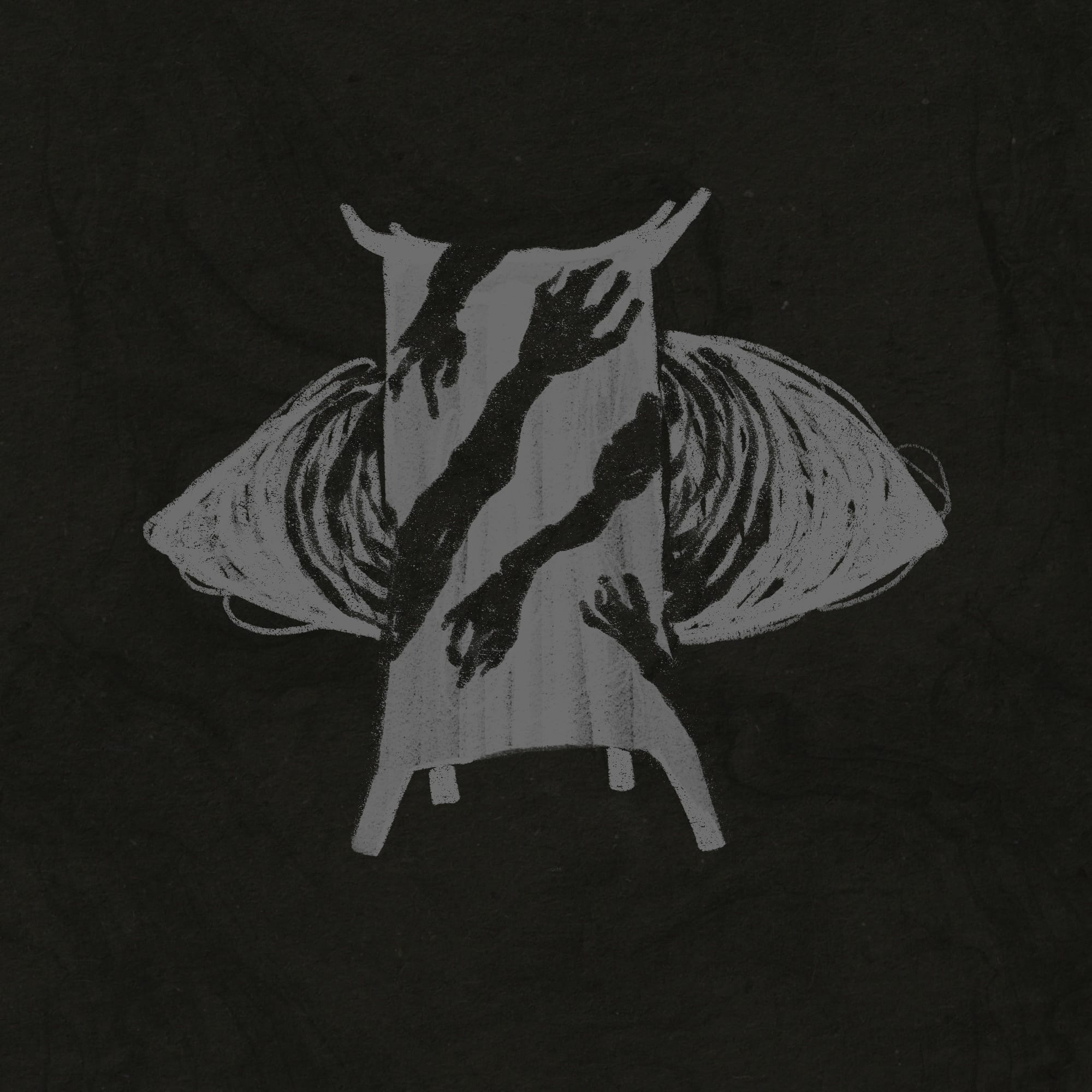
A hand snaked itself out from behind the throne, connected to an impossibly thin wrist, and grabbed the golden back of it. Two eyes with smoldering red irises, black where they should have been white, peered out from the space between the chair’s back and seat.
Val’s scream caught in her throat, her body frozen.
Arm over arm, leg over leg, its body an enormous, bubbling mass of flesh; it pulled itself up over the seat of the chair and inspected Val, jagged sideways mouth emitting the coos of an infant and the screech of an eagle amid prehistoric clicks from its long, thin neck.
They locked eyes and she felt raw power rolling from it in waves. She tasted toasted golden fields of prosperity, fragrant, piquant waves of rival blood. The arresting officer, the judge, her mother, her father, Iggy, the basement girls.
She shook her head violently and retched. No, not them.
It grew tired of observing.
For how bulbous it was, it moved as quickly as falling water. Her instinct was to roll.
The creature sliced through the air behind her and spun fluidly, centering its gaze on her as she crawled toward the attic ladder.
It screeched, a cacophony of babies and women and men and persons and the sands of time and tectonic plates rubbing against one another. Val finally did scream, blood erupting from her ears.
It scrabbled toward her, smiling vacantly with its rows of grey tombstone teeth. Val hurled herself toward the statues. She grabbed the pommel of the headless man’s sword—the blind leading the blind—and yanked it out from between his yielding hands with a scrape.
Gracias a Dios.
It was decorative, but real metal and sharp. She rounded, holding it out in front of her, knowing full well she’d never held any weapon except for Iggy’s Glock when he got scared he’d shoot all the basement girls before he could sell them.
He'd been a shivering mess, pacing from grimy mattress to window, smoking another hit of meth as he peered through the plastic blinds, waiting for the red and blue flashes.
Shoot me, Valeria, just shoot me!
Fifteen-year-old Val, pregnant, eyes running with tears and nose running with snot, sitting on the gun so he couldn’t pry it from her as easy, praying the safety was on.
The creature moved forward until the tip of the sword pressed into its flesh, a single spot of black ooze pooling around the tip. It smelled like rosewater and gasoline. It leaned its face close to Val’s, head wobbling on its thin neck. Its breath stank of carrion. Again, she felt a wave of longing wash through her. She felt the urge to touch its slick hide. It smiled lazily, reeling her in.
It made another sound, like Darcey, hungry in the black morning hours. The trance broken, Val shoved the blade forward with all her might and sliced downward, cutting another shriek from the creature as ichor spilled to the floor. Val’s ears pulsed dangerously and she smelled copper. A hot droplet slid down the contour of her jaw and neck.
Staggering into the tables, Val snatched up a silk and wrapped it around her arm, then turned to face the monster.
It was in the position she had left it, curled into itself, the substance dripping from its middle, pooling around its feet smelling less like roses and more like gasoline by the second.
It twisted its head from one side to the other like a snake tasting the air, mouth still a grin, eyes lidless.
Two centuries have passed since I have been offered someone worthy. You smell like the others, but you are different—aren’t you, Valeria?
The voice was a whisper, cool and seductive, beautiful even, and it bounced around the inside of Val’s head as if the thought was her own. It took two steps to the left and Val moved to the right—a wide, slow circle.
When this family earned me as its patron, they were warriors. Strong. I made them stronger, and they nourished me. But their offspring are weak. Pitiful. It spat a large glob of reeking murk onto the tiles. Softened and made useless by my opulence. They no longer perform the rites. They no longer take heads in my name.
Val continued placing one foot behind, one foot ahead, a sideways crouch toward the wall of candles.
But you, Valeria. I know the heads that you have taken.
The basement girls watched, blankly, through the attic’s hatch.
I can make you even stronger. I can fulfill your desires.
The taste of warm, mulled wine exploded on her tongue, slid down her throat. Her mouth watered helplessly. It chuckled, the sound of stones thrown into a woodchipper.
Do you see? Leave mortality; walk with my blood in your veins. Leave your fears and weaknesses on this plane, with the unworthy.
A thick, black tongue unfurled from its mouth and licked ooze from its teeth. It took a step forward into the center of the circle. Val’s pulse quickened and she quickly sidestepped twice more. The heat from the candles pressed against her back.
Leave everything. Empty yourself for nothing but me, and I can make you as a god.
Its voice held the sharp promise of a vodka shot, the warmth of knife-scarred hands, the lilt of false adoration, but there was nothing left to leave behind. She’d known what it was like to be emptied for someone, and the unquenchable thirst to be full of herself again.
Everything that mattered was in front of her—just a little further down the road.
Val flicked the length of silk from her forearm and touched it to one of the candle flames, watching the fine threads sizzle and pop as they caught. Fingertips burning, she threw the fiery offering at the creature.
It stuck to its front, searing the flesh with a hiss.
It screamed as it fell to its spindly knees, batting furiously at the still-burning fabric adhered to its skin.
Val shot forward, blade-first, and ran through its gelatinous body over and over until her hands were sticking to the grip and her feet were sticking to the tile, ichor obscuring everything. Hot putrescence shot from its dying form like a geyser, slicking her hair, leaving her with nothing but the whites of her eyes in the darkness.
The creature laid in a heap, unmoving, but Val sawed the ornamental sword’s edge against its cord-like neck and severed the head entirely, just in case. It felt like the right way to kill a god and ensure it doesn’t come back looking for you.
The ichor began to catch fire like pitch. Val panted; the heat was overwhelming. If it touched her, she’d be a torch. She backed herself towards the attic’s hatch. The basement girls were gone.
She climbed down as tongues of flame began to lick the opening, ran through the lush carpeting and down the stairs, outrunning her funeral pyre.
The thousand dollars was still sitting on the coffee table. Val snatched it, pocketed it. Her throat was hot; the smoke was starting to fill the lower rooms. She looked over at the bar, thought of the vodka in the freezer.
Let it burn.
Val darted across the foyer into the dining room and picked up a leather upholstered chair with burnished iron legs. She hefted it onto her right shoulder, then threw it as hard as she could at the window.
The glass didn’t break, but a hairline crack split the pane into six jagged sections. She coughed as smoke spilled down the stairs. Every smoke detector was screaming.
Val lifted the chair again, head swimming. She threw it at the window, heard the sound of glass shattering, and crawled out into the night, hissing as she felt the skin of her palms and forearms tear.
She ran to her Accent, unlocked the doors, and cursed at it until the engine turned over, then drove down the winding driveway until she reached the gates, which opened automatically at her presence. Lion’s Head was an explosion of sunset colors, the moon watching over its demise. Val watched it burn through her rearview mirror, heart pounding, until she was sure it couldn’t be saved—until she was sure she couldn’t go back and change her mind.
The gas tank was nearly empty, the transmission had about ten miles left on it—at most—but the cash in her pocket felt as heavy and comforting as a full stomach. A fixed car, gas, a meal, maybe a rest-stop present for Darcey. Maybe something for her mom and dad. What could you get from a rest stop that adequately portrayed I’m sorry I fucked everything up?
A group of teenagers, out past their curfew and wearing masks a day early, stood across the street, watching the blaze. A bottle of vodka lay discarded by their feet. No one was out looking for them.
Val felt a tug, umbilical, calling her from the east. She turned her wheel away from burning attics and basements, bottles and bodies exploding from heat and pressure.
Val turned toward the life she’d saved, and the life she was saving.